

#348 Pause and Think
India's Declining Fertility Rate - an Opportunity; and Does India Have Any Leverage Against the US and China?
India Policy Watch: Caution, Women Not At Work
Insights on current policy issues in India
—RSJ
This chart in The Economist last week caught my eye. The data wasn’t a surprise, but the way it was framed (Subcontinental Scandinavia) did make me pause.

We have written a lot in the past about how having a young, working-age population is an advantage for a nation, contrary to the usual claims in India about population being a problem. As the chart above shows, we have taken the ‘population is a problem’ too far, too soon. We have gone from a Total Fertility Rate (TFR) of 3 to 2 in under 12 years; possibly the fastest such transition in the past century. Most of the developed economies of today took more than half a century for a similar drop. We have reached a TFR of under 2 now at a per capita of about US$3000, while such levels were reached by other economies at more than US$15,000.
Except Japan and China, who were at similar levels of per capita as us but then set a scorching pace of economic growth of above 8 per cent (in USD terms) for almost 25 years. Given the current trend of TFR in India and life expectancy, India will have a median age of 40 years by 2050 (give or take a couple of years) from the current median of 30. That’s the threshold median age when economic growth slows down considerably, as past data has shown. This might be worsened by the adoption of technology and AI in the economy. To put it simply, India has about 25 years to go from a $3000 per capita “lower-middle” economy to a $15,000 per capita “upper-middle” economy. This will need an 8 per cent dollar-denominated CAGR for the next 25 years. I don’t want to be a pessimist, but this looks improbable. It is almost certain that India will grow old before it gets rich.
Uniquely, as the data shows, India has taken the trappings of an advanced economy like smaller families, female literacy (girls consistently outperform boys in tests) and women participation in household decision making, while simultaneously going down on female participation in the labour force. Part of it can be explained by the historic trend across the world - when a society comes out of abject poverty, female participation in the workforce reduces till it hits a bottom and then begins to rise as the society gets richer. In India, this upward move isn’t happening (or happening fast enough). So, we have a situation of TFR falling rapidly, women’s health parameters and infant mortality getting better, but the economy is not benefiting from an increase in female labour force participation.
This issue has not yet entered public discussion with sufficient urgency. Population is still a happy punching bag for politicians for India’s ills, with the added advantage of demonising the Muslim community for contributing to it. The data, of course, suggests no such correlation. For most of the past two decades, policymakers, investors and economists have taken comfort in the idea that India possessed a long runway of demographic advantage. While much of the developed world was ageing, India remained young. This demographic dividend became one of the central assumptions underlying projections of sustained high growth and rising prosperity.
Economies create growth through some combination of labour, capital and productivity. India can certainly invest more capital. It can improve productivity through technology, infrastructure and better institutions. But the labour component of the growth equation is important because it is somewhat finite in a cycle. The labour force growth itself slows as fertility declines. So, quite simply, India has to find ways to invest in and increase labour participation in productive assets before time runs out. The largest untapped source of labour available to the Indian economy today is not hidden in some remote geography or waiting to be unlocked by a new industrial policy. It already exists within the country’s educated population. It consists of millions of women who have acquired skills, education and aspirations but remain outside productive paid employment.
By many social indicators, India has made extraordinary progress on gender metrics. The latest Women and Men in India report (2025) published by MOSPI documents changes that would have seemed improbable a generation ago. Women now have a higher gross enrolment ratio in higher education than men, with female enrolment standing at 30.2 compared with 28.9 for males. Gender gaps in school enrolment have narrowed dramatically. Women are entering professional education in larger numbers. The number of women in managerial positions has more than doubled over the past decade. Household conditions have improved significantly through electrification, LPG penetration, better housing and improved access to water. Fertility has fallen, family sizes have become smaller, and women are spending more years in education than ever before.
In many respects, Indian society has become considerably less restrictive than it was even twenty years ago. Families across income groups are investing in their daughters in ways that would have been unusual for previous generations. The idea that women should receive higher education is no longer unusual across large parts of the country. Parents who once viewed education primarily as a means of improving marriage prospects increasingly view it as an investment in capability and opportunity. Yet the labour market has failed to keep pace with these social changes.
Official data shows female labour force participation reaching around 40 per cent in recent years, an improvement from earlier levels and a statistic that the government understandably highlights. But this is dressing up the reality. Male labour force participation remains close to 80 per cent. Female worker participation remains roughly half that level. More importantly, the quality of employment remains a serious concern. A substantial proportion of working women continue to be concentrated in agriculture, informal employment and self-employment, sectors that are characterised by low productivity, low earnings and limited opportunities for advancement.
The issue, therefore, is not simply that too few women work. The issue is that too few women have access to productive, well-paying and sustainable employment.
For many years, low female labour force participation in India was explained primarily through the lens of social norms, educational deficits and household restrictions. But they are becoming less convincing as a complete explanation for current realities. The more plausible explanation is that the demand side of the labour market has not evolved rapidly enough.
The estimates are that roughly 125 million women with secondary education or above remain outside the labour force. Among them are approximately 35 million graduates and postgraduates. These are depressing statistics. The economy is creating opportunities for some women, particularly at the upper end of the skill distribution, but not at the scale required to absorb the growing pool of educated female talent. This reflects a broader feature of India’s development path. Historically, large increases in female labour force participation have been associated with structural shifts in employment. Industrialisation absorbed women into factories. The expansion of healthcare, education, administration and business services created large numbers of white-collar jobs. The growth of care industries generated additional opportunities. Women entered the workforce not simply because social norms changed but because economies created jobs worth entering.
India’s experience has been more uneven. We have produced globally competitive sectors in information technology, financial services and a range of professional occupations. It has also generated large numbers of jobs in construction, trade and informal services. What it has not created in sufficient scale is the broad middle layer of employment that historically drew women into the workforce in many successful development stories. Labour-intensive manufacturing remains smaller than it should be. Healthcare and care services are underdeveloped relative to the country’s needs. Administrative and business support sectors have not expanded enough to absorb the numbers entering higher education.
As a result, many women find themselves facing an unattractive choice. They can remain outside the labour force, or they can enter forms of employment that offer limited earnings, weak career progression and little economic security. The decision to stay out of the workforce is often interpreted as evidence of social conservatism. As education levels rise, reservation wages rise as well. An educated woman is less willing to spend long hours in low-productivity informal employment for meagre pay. In many parts of the country, the choice is not between a good job and staying at home. It is between a bad job and staying at home. The more than modest success on social metrics of women in India right now is paradoxically hurting its economic progress because the demand side of the equation for women hasn’t kept pace.
As countries become richer, a growing share of care responsibilities is transferred from households to institutions. Childcare centres, schools, eldercare services and other forms of support infrastructure allow greater participation in paid employment. India has invested in roads, airports, ports and digital infrastructure over the past decade. Those investments were necessary and will continue to be important, but the next phase of development may require comparable attention to the infrastructure that enables labour force participation itself.
There are limits to how rapidly productivity can improve across a large and diverse economy. Bringing more women into productive employment is one of the few available levers capable of delivering meaningful gains across multiple dimensions simultaneously. It expands the workforce, raises household incomes, improves human capital utilisation and strengthens long-term growth potential. India needs faster growth in labour-intensive manufacturing and substantial expansion in healthcare, education and care services. Women don’t want permanent exits from the labour force; they need accommodation at key lifecycle stages. Childbirth, caregiving and household responsibilities tend to be career-ending moves for women. Flexible work arrangements, part-time opportunities, remote work, returnship programmes and reskilling initiatives can therefore have a disproportionate impact. Equally important is the need to remove outdated restrictions that continue to treat women as workers requiring special protection rather than equal opportunity. Economic participation expands when regulations presume capability and enable it to be used.
India has already achieved something remarkable by bringing millions of women into schools, colleges and universities. The demographic dividend that has underpinned so much optimism about India’s future is not an inexhaustible asset. It is a temporary opportunity. Whether India reaches developed-country status before demographic ageing begins to constrain growth will depend in no small measure on whether the economy can make productive use of the capabilities of the women it has spent decades educating.
Matsyanyaaya: India Has Leverage
Big fish eating small fish = Foreign Policy in action
—Pranay Kotasthane
Two events this week crystallised a question that has been making the rounds in discussions on Indian foreign policy over the last year.
On Wednesday, the US military struck commercial vessels in the Strait of Hormuz as part of its naval blockade of Iranian ports, killing three Indian sailors aboard the Palau-flagged MT Settebello off Oman’s coast. Hours earlier, another Palau-flagged vessel carrying 24 Indian sailors had also been hit. India summoned a senior US diplomat in New Delhi to demand an explanation.
Even after the Indian external affairs minister raised this issue with his counterpart, Rubio offered no apology for killing civilians. Essentially, Indian citizens died in an American military operation, on non-Indian vessels, in international waters, with no meaningful US acknowledgement of Indian lives lost.
Then on Friday evening, the US Commerce Department issued an export control directive barring all foreign nationals—including those living and working in the US—from accessing Anthropic’s newly released Fable 5 and Mythos 5 AI models. Anthropic had no choice but to disable the models for everyone. India had signed the Pax Silica declaration barely four months earlier, in February 2026, joining a US-led coalition explicitly designed to build “trusted” technology supply chains. The Pax Silica declaration speaks of “mutual economic security” and “trustworthy systems.” Four months later, the most advanced AI model on the market was yanked away from every Indian user and developer without warning, without consultation, and without any distinction between Pax Silica allies and adversaries.
These two events are different in domain but identical in structure. Both demonstrate that the US will now act unilaterally regardless of the costs imposed on partners. Both reveal that India’s current posture generates no meaningful deterrent. And both raise the question that’s come up many times since the tariffs on India: doesn’t India have any leverage over the US?
The Leverage Fallacy
The instinctive response in Indian strategic circles is that India cannot afford to push back against the US. The GDP disparity is too large. The military asymmetry is too vast. The technological dependence is too deep, and any retaliation would invite counter-retaliation that India cannot absorb.
This is analytically wrong. If leverage were purely a function of aggregate national power, Sri Lanka would have zero leverage over India, and the Maldives would have even less. Yet both states routinely extract concessions from New Delhi. Both play on Indian security anxieties against Chinese infrastructure investments to extract concessions. Neither state is “powerful” by any gross metric. Both generate leverage through the density of their relationships and their willingness to absorb costs.
This tells us that leverage is not a property of national size. It is a product of three factors: the density of interrelationships between two states, the asymmetry of vulnerability in specific domains, and the willingness to endure short-term costs to establish long-term red lines. Come to think of it, every country, whatever its size, can exercise some leverage.
You Play the Cards You Have
The main point is that a nation-state has to play the cards it has, not the ones it wants. On most occasions, it is sensible to avoid antagonising the bigger power, but sometimes there’s a need to behave unreasonably. And judging by its responses to Brazil and China, that’s precisely the stance that this US administration notices. And remember, this is coming from someone who has consistently batted for deeper India-US ties. Evidence now suggests that the stance is proving counterproductive.
Thus, a framework is needed to analyse India's leverage against larger powers. Broadly, there are seven factors that can help us assess any leverage. This is based on David Baldwin’s relational theory of economic statecraft, the Keohane-Nye model of complex interdependence, and empirical analysis of contemporary supply-chain weaponisation.
Asymmetry of Vulnerability, i.e., who suffers more? For leverage to exist, the target state must be more exposed than the acting state in the specific domain.
Political Salience in the Target State, i.e., does it generate domestic political pain?
Leverage is only as powerful as the political costs it triggers in the target state.
Target State’s Substitutability, i.e., can India find alternatives if the US retaliates? Every act of leverage invites counter-retaliation. India must assess whether it can source alternative suppliers, markets, or partners if the US responds.
Acting State’s Substitutability, i.e., can the US replace what India provides? If the US can easily redirect its exports or find alternative markets, Indian leverage evaporates.
Reversibility, i.e., can India walk it back without permanent self-damage?
The best leverage actions are those that can be calibrated, escalated, and de-escalated.
Credibility Impact, i.e., does it hurt India’s reputation with third parties?
Every leverage action is observed by every other potential partner. Actions that instil fear in all partners are costly.
Signal Clarity, i.e., does the action unambiguously communicate a red line?
A leverage action that the target cannot clearly interpret is wasted.
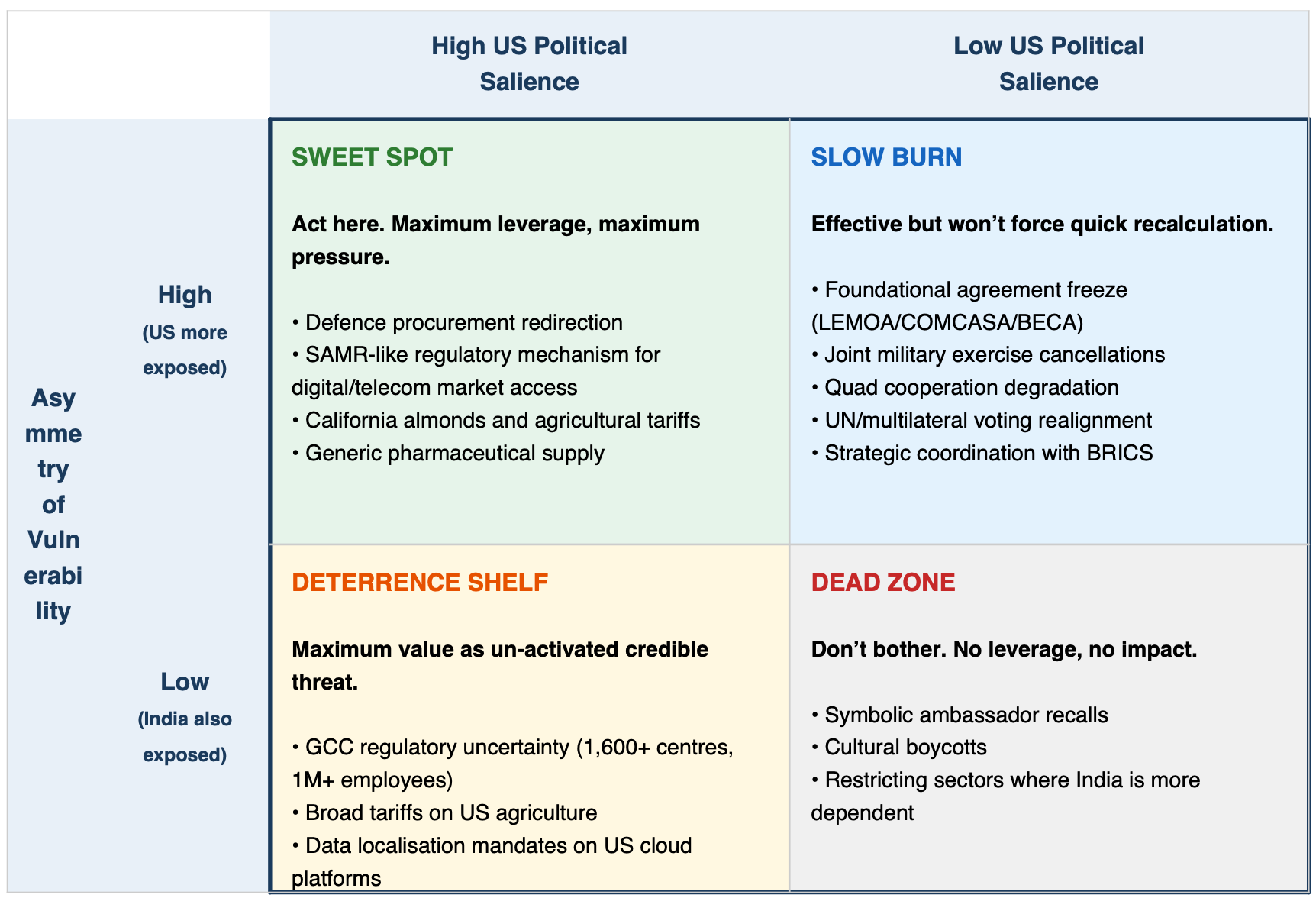
Of these seven factors, I guess the most important ones for India are the first two. The others can be rolled up together. The two factors generate a 2×2 matrix.
The Menu of Options
The Sweet Spot is where India should act. There is a high asymmetry of vulnerability favouring India, and these actions will have high political salience in the US. Some candidate actions for this category are:
Defence procurement redirection. US defence contractors maintain the most powerful lobbying operations in Washington with deep ties to congressional delegations across multiple states. India has credible alternatives: Dassault, Saab, and increasingly capable domestic platforms. Redirecting even one pending contract worth $2–5 billion sends shockwaves through defence-state congressional delegations. The signal is unmistakable, and the action is partially reversible through future procurement cycles.
A SAMR-equivalent regulatory mechanism is the highest-value long-term investment. China’s State Administration for Market Regulation (SAMR) has demonstrated how a populous nation can weaponise market access as a geopolitical instrument. It blocked Intel’s $5.4 billion acquisition of Tower Semiconductor in retaliation for US chip sanctions and delayed Broadcom’s $69 billion VMware acquisition. India is the decisive growth market for US Big Tech in digital payments, e-commerce, cloud infrastructure, and telecom equipment. A regulatory body with genuine authority over merger approvals, data localisation, and source-code escrow requirements would give India a standing institutional capacity to impose financial pain on the most effective lobbying entities in Washington. The critical caveat is that this must be built as a standing institution that demonstrates rules-based behaviour toward all partners, not as an ad hoc retaliatory mechanism.
California almond tariffs are a proven, low-risk lever. India is one of the largest export markets for California almonds. India has already used this lever before. The almond growers’ lobby in California’s Central Valley is politically organised and acutely anxious about losing the Indian market. Consumer price impact in India is marginal. The action is highly reversible; and tariffs can be imposed and removed within weeks.
Generic pharmaceutical supply works best as a declared red line rather than an activated measure. India supplies approximately 40% of the US generic drug volume. A disruption would be felt immediately by voters, hospitals, and insurance companies. The political salience is extreme, but the asymmetry is time-limited before US alternatives mature.
The Slow Burn quadrant contains military-strategic actions that operate through the Pentagon and NSC rather than through domestic US lobbying. Freezing the implementation of the foundational defence agreements (LEMOA, COMCASA, BECA) would degrade US force-projection capability in the Indian Ocean. Cancelling flagship joint exercises involving the US would be the most publicly visible military signal, instantly legible to partners as a relationship downgrade. Both carry a cost that they weaken India’s own deterrent posture against China. But as brief, visible signals, they communicate resolve without permanently degrading interoperability.
The Deterrence Shelf holds India’s most powerful latent threat: the 1,800+ Global Capability Centres employing over one million Indians. These are core R&D and engineering operations for US multinationals, structurally embedded in how these firms function. Replicating Bangalore’s talent density takes years. But activating GCC restrictions would directly hurt employment in India. The mere existence of regulatory uncertainty around GCCs, whether arising from a rule or a new governing body, acts as a deterrent. Swaminathan Aiyar’s proposal to grant compulsory licenses to Indian pharma firms to produce a couple of drugs that are still under patent also falls in this category.
A Reminder
The Fable 5 episode and the Hormuz killings reiterate that this US administration will continue to act unilaterally against Indian interests. Diplomatic summons and strongly worded statements will continue to be ignored. The only language that registers in Washington is the language of costs, specifically, costs borne by domestic constituencies with the political organisation to demand policy change.
India does not need to match the US in aggregate power to impose those costs. It needs to be selective, disciplined, and willing to absorb short-term friction for long-term positioning. Remember, these actions are not about some vague notion of “standing up” to the bigger powers. They are merely about changing the US’s calculus in a calm and clinical manner.
HomeWork
Reading and listening recommendations on public policy matters
[Paper] This paper on the sudden jump in the number of technology collaborations between middle powers debuts a concept called ‘workarounding.’ Using empirical data on tech partnerships, the authors suggest:
“workarounding can have long-term implications for international cooperation, technological progress, and the global economy. The impact is cumulative. One agreement will not change the international order. But dozens or hundreds of agreements across energy, technology, ports, data, defense, finance, and industrial policy begin to create a different reality. They give middle powers more options and more bargaining power.”
[Paper] This EU2031 paper is a nice attempt at articulating what Europe’s AI future might look like if it continues on the current trajectory. Though I do not agree with its bombastic conclusions about the AI takeoff, this is a worthwhile exercise for India.
[Puliyabaazi] Our discussion proposes a way out of India’s entrance exam dilemma.
[Article] The EU’s tech sovereignty package should interest countries like India because it has specific provisions for trusted partners, argues Mathieu Duchâtel.
Indian state has become too sensitive to local political turbulence to take any of the above mentioned steps. Retaliation requires political will and intent.
Useful framework, but I'd push back on how much usable leverage India actually has right now. The dependencies run deeper than the piece suggests. Our frontline fighters fly on GE engines — that's a chokehold, not a contract we can redirect overnight. The GCCs employ a million-plus Indians, which makes them as much a hostage as a weapon: restricting them hurts our own employment before it hurts the multinationals. And the entire digital foundation — servers, GPUs, desktop and mobile OS — is American.
So the honest position is uncomfortable: digitally we depend on the US, in manufacturing we depend on China. Leverage you can't pull without bleeding yourself isn't really leverage.
The almonds-and-tariffs menu is fine for sending signals, but it doesn't move the structural picture.
What would is building a third axis - and Europe is the obvious partner. Co-develop, co-use, co-export across both tech and manufacturing, so the dependence becomes mutual rather than one-directional. Europe needs the same hedge against a Trump–Xi world that India does. Durable leverage comes from being indispensable to someone, not from being able to inconvenience them.
I've written more on exactly this — why India and Europe need each other as that third axis: https://rajdoot12.substack.com/p/trump-xi-2026-why-india-and-europe?r=85l1yf&utm_campaign=post-expanded-share&utm_medium=web