

#356 When Will China Block Its Open-weight Models?
What do Unchanged Repo Rates Signal? Why is China Giving Away its AI Models? What Does the Makkah Defence Pact Mean for India?
India Policy Watch: A Capital Question
Insights on current policy issues in India
—RSJ
The Monetary Policy Committee (MPC) met this week and unsurprisingly kept the repo rate unchanged. What surprised me was the continued dovish tone, though the official line was that it was neutral. The Governor played with a straight bat when asked about his view of the economy, mixing the usual optimism with enough caveats for his comments to be interpreted either way. From the press conference:
“Growth, although resilient, is expected to be lower in this financial year. The outlook, however, is hazy because of the uncertainties regarding South’s global trade policy. There is a need for greater clarity to emerge, especially regarding inflation, its path and composition before taking any policy action.
The impact of El Nino on the temporal and spatial distribution of rainfall remains a major risk. Global oil prices have also remained highly volatile, with sharp two-way movements triggered by geopolitical developments, blurring the near-term inflation outlook. While generalised inflation pressures remain modest so far, the risk of second-round effects from higher food, fuel and other input costs translating into broader-based inflation persists.”
I have not written about the economy for a while, but beyond the rate conversation, I was surprised by the accommodative stance. We are still in the early part of a fiscal year that has seen an energy shock, a continued weak rupee and upward-trending global interest rates. So, you would expect the central bank to sound a tad less relaxed about inflation. I mean, yes, it is true that despite the war and accompanying supply chain disruptions and high oil prices, inflation has stayed within bounds so far. The pass-through from higher crude prices to retail prices has been contained, core inflation is below 4 per cent, and there is no price issue pinching the citizens. The RBI expects headline inflation to peak in the next quarter and then ease. Its view is that the recent inflation rise is also a normalisation from a low base last year.
That’s one side of the story though. Monetary policy is supposed to be forward-looking with the objective of price stability. Inflation is expected to average above 5 per cent over the next three quarters. That assumes a somewhat benign global macro and a continued confidence in high crude prices not getting passed on to the wider economy. The other way to look at the stance is through the real policy rate. With one-year-ahead inflation projected at roughly 5.3 per cent and the repo rate at 5.25 per cent, the expected real policy rate is close to zero. The historical average of India’s neutral real rate, depending on the methodology, tends to sit somewhere around 1.4 to 1.8 per cent. At that real rate, the economy is broadly in balance, with monetary policy neither adding to nor taking away from demand. So, a real policy rate around zero is significantly accommodative.
This rate posture is at odds with what we heard from the RBI on growth. So far, the spillovers from the West Asia conflict have been better managed than many expected. The RBI has revised its FY27 growth projection higher, to 6.7 per cent, and high-frequency indicators continue to suggest good momentum rather than any slowdown. First-quarter GDP growth could even come in well above 7 per cent, given the indications. Unless the central bank feels this growth is transient (or maybe not even real), this stance doesn’t make sense.
In that context, I found the emphasis on core inflation by the Governor intriguing. Core inflation gives us an idea about demand-side pressures and the persistence of inflation once the volatile components (fuel and food) are removed. Our inflation-targeting framework was designed around headline CPI for a reason. We should certainly monitor core inflation, but we should be careful about allowing it to become the main measure of inflation simply because it makes the current policy stance easier to defend.
The interest-rate differential between India and the US has narrowed considerably. Global capital flow will come only if, after adjusting for currency, risk and the return available elsewhere, India looks attractive. If we remain an outlier while other EMs continue to raise rates, we will see capital flowing out. We have already seen how much effort is going into keeping dollars coming in. The FCNR deposit arrangement, under which the RBI takes on the currency risk, has attracted around $40 billion already and could double by the time the window closes in September. This has given short-term support to the rupee, but I am not sure we should treat it as a structural solution. When these deposits mature in 3-5 years, we will have the problem of managing the withdrawals.
Right now we seem to be running out of real ideas for making capital want to stay.
There is a steady stream of large IPOs coming through, providing PE investors and founders with an exit through public market funds. There is a good argument that if foreign investors make good money on Indian companies, they will develop greater confidence in Indian entrepreneurs and return with more capital. I am less convinced that this follows automatically. The IPO boom should not be read only as a sign of confidence. It is also an exit mechanism. An investor deciding that India is where they want to deploy their next ten years of capital is betting on the country’s future.
We have spent years talking about ease of doing business. To be sure, there has been real progress in several areas. But investors have a long memory for unpredictability. Just in the past year, we have seen retrospective tax being imposed on gaming companies (we love retrospective policy changes), abrupt regulatory interventions in the insurance sector, public apology sought from social media companies for imagined slights or changing the rules of the game midway that end up helping a couple of domestic conglomerates.
There is a seductive argument that India is now such a large market that global companies need us more than we need them. Therefore, we can afford to throw our weight around. This is a bit of a pipe dream. India is a large market, but for most global technology companies it is still only a small share of global revenue. China is a good example to follow here, where they stayed under the radar till late before they started flexing their muscles.
The better way to create leverage is to make these companies deeply invested in India by building data centres, scaling up GCCs and developing local supply chains. Nothing creates leverage more than billions of dollars of large, immovable investment in India. This is critical because we need foreign capital for every strategic ambition we have. We want to create jobs at a scale that the services economy alone cannot provide. It requires capital that is willing to stay for a long time. Like other pieces I have written of late here, jobs are where this discussion eventually ends up. Over the past four years, we have seen that we can have respectable GDP growth and still not create enough productive employment.
We can keep doing the band-aid stuff to manage the macro metrics. The intent to keep real rates at almost zero to support demand, the RBI support to bring FCNR inflows to support the currency and the song and dance about IPOs providing good exits to foreign investors are all part of this. I am not sure if these are long-term solutions to draw capital into India. That answer lies in doing the hard stuff and I have a feeling (expressed before too), that the PM has given up on this battle. Young Indians are not experiencing GDP growth in the real sense. They experience the reality of fewer quality jobs, their salaries stagnating, of not being able to afford a house as easily as their parents and feeling less hopeful about their lives tomorrow. This frustration, I’m afraid, will get expressed elsewhere, through greater demand for government jobs, subsidies, reservations and other forms of state support.
We need capital that stays and builds things in India.
Matsyanyaaya: When Will China Block Its Open-weight Models?
Big fish eating small fish = Foreign Policy in action
—Pranay Kotasthane
China’s open-weight models are making waves across the world. Even as their popularity and usage soars, reports suggest that China’s Ministry of Commerce (MofCom) has begun consulting AI firms to restrict the export of models.
Thus, some of us at Takshashila decided to go deep and systematically answer three questions: why is China allowing the export of AI models? Under what conditions might it block the export of open-weight models? And what might these restrictions look like? The full paper is here. What follows is a bloggy version of it.
There are five reasons that can explain why so many open-weight models are being exported out of China. Some of them are complementary while some are mutually exclusive. Here’s a quick survey.
Reason 1: It costs less than it looks
The most straightforward explanation is that Chinese firms are not spending what American labs spend. DeepSeek disclosed in a peer-reviewed Nature article that its R1 reasoning model cost $294,000 to train using 512 Nvidia H800 chips, dramatically below the hundreds of millions spent by US frontier labs.
Two techniques explain the gap. First, distillation. Chinese labs have been accused of industrial-scale training on the outputs of American models, radically compressing R&D costs. Second, architectural efficiency. DeepSeek’s mixture-of-experts architecture, developed under the pressure of US export controls, activates only a fraction of parameters per query.
Reason 2: Geopolitical prestige
Open-weight models are a visible demonstration that China can compete at the AI frontier. DeepSeek’s January 2025 release triggered the largest single-day market cap loss in US stock market history, wiping roughly $1 trillion from tech stocks.
The Chinese Academy of Sciences has institutionalised this view. One paper called for building a national open-source AI ecosystem, arguing that DeepSeek had “raised China’s AI research application level and international influence.” This is the closest thing to an official Chinese articulation of the prestige motive.
Reason 3: Undermining the opponent’s business model
A classic competitive strategy is to commoditise your competitor’s core product. Open-weight models need not be strictly superior; they merely need to be good enough for most commercial applications. Every time a Chinese open-weight model demonstrates competitive performance at lower costs, it compresses the pricing power of American labs.
Reason 4: China can absorb the costs
Even if open-weighting is more expensive than Reason 1 suggests, China’s capacity to mobilise capital for strategic technology is formidable. Since 2014, China’s state-led investment in semiconductors alone has exceeded $150 billion. Provincial governments offer compute vouchers covering 20-50% of cloud computing costs.
The foundational mechanism is financial repression. By maintaining capital controls and a state-dominated banking system, Beijing keeps domestic savings captive within state-owned banks, providing artificially cheap capital. This produces the same overcapacity pattern seen in solar panels and EVs—making Chinese producers the default global suppliers at prices competitors cannot match.
Reason 5: The infrastructure play
The most interesting explanation concerns what happens downstream of model release. Free models accelerate global AI adoption. Global AI adoption drives demand for energy, physical infrastructure, and hardware. China dominates the supply of all three.
Alibaba chairperson Joe Tsai articulated the business logic explicitly: “The way we benefit from open source is that it will drive demand for AI, it will drive training needs, and we see in the future a lot of needs for inference.” Alibaba’s cloud revenue grew 34% year-on-year in the September 2025 quarter, with AI-related revenue posting triple-digit growth, driven by developers building on free Qwen models using Alibaba’s paid cloud infrastructure.
The U.S.-China Economic and Security Review Commission’s “Two Loops” report argues this is “not a second-best adaptation to semiconductor export controls, but a coherent doctrine” combining a digital loop (open-model innovation) with a physical loop (large-scale deployment generating real-world data feeding back into model improvement).
The five explanations are not of equal analytical status. They can be divided into two groups: reasons that rest on assumptions about the same empirical facts but reach different conclusions, and reasons that are complementary.
Reasons 1 and 4 rest on opposing assumptions about how much open-weighting costs. Reason 1 says costs are low enough that open release is rational without state support. Reason 4 says costs may be substantial but absorbable thanks to China’s capital mobilisation infrastructure. Both support open-weighting, but for different reasons. Empirically, both may be partially true: distillation and architectural efficiency reduce costs (supporting Reason 1), but the remaining costs are large enough that subsidised capital environments still matter (supporting Reason 4). Similarly, Reasons 2 and 4 rest on opposing assumptions about intent. Reason 2 posits conscious geopolitical strategy. Reason 4 posits structural overinvestment without any explicit geopolitical aim. They can coexist if state-level actors exploit a structural dynamic they did not create, i.e., Beijing recognises the open-weight wave’s geopolitical utility and amplifies it without having initiated it.
Reasons 3 and 5 are mutually reinforcing. Reason 3 attacks the opponent’s revenue model while Reason 5 builds China’s own. Together, they can form a pincer strategy of compressing American AI labs’ ability to monetise proprietary models while simultaneously capturing value at the infrastructure layer.
Taken together, the five reasons suggest that China’s open-weight strategy is overdetermined, i.e., it is supported by more independent logics than would be necessary to justify it. Strategies with multiple reinforcing rationales tend to be durable. Even if one reason weakens, others remain in force.
When Might Beijing Close the Tap?
The analysis predicts this openness is not permanent. Using a causal loop analysis, we find that three thresholds must be crossed before China shifts to graduated restrictions:
Domestic consolidation: The “Hundred Model War” must consolidate to an oligopoly of 5-8 full-stack giants. Beijing can coordinate five firms; it cannot coordinate seven hundred. This threshold is underway.
Ecosystem lock-in: Global developers must be deeply integrated with Chinese cloud infrastructure, making switching costly. This requires 12-18 more months of cloud flywheel maturation.
Commoditisation saturation: The marginal strategic value of further open releases must approach zero, i.e. non-Chinese labs should independently sustain the commoditisation regardless of China’s contributions. This threshold hasn’t been reached yet.
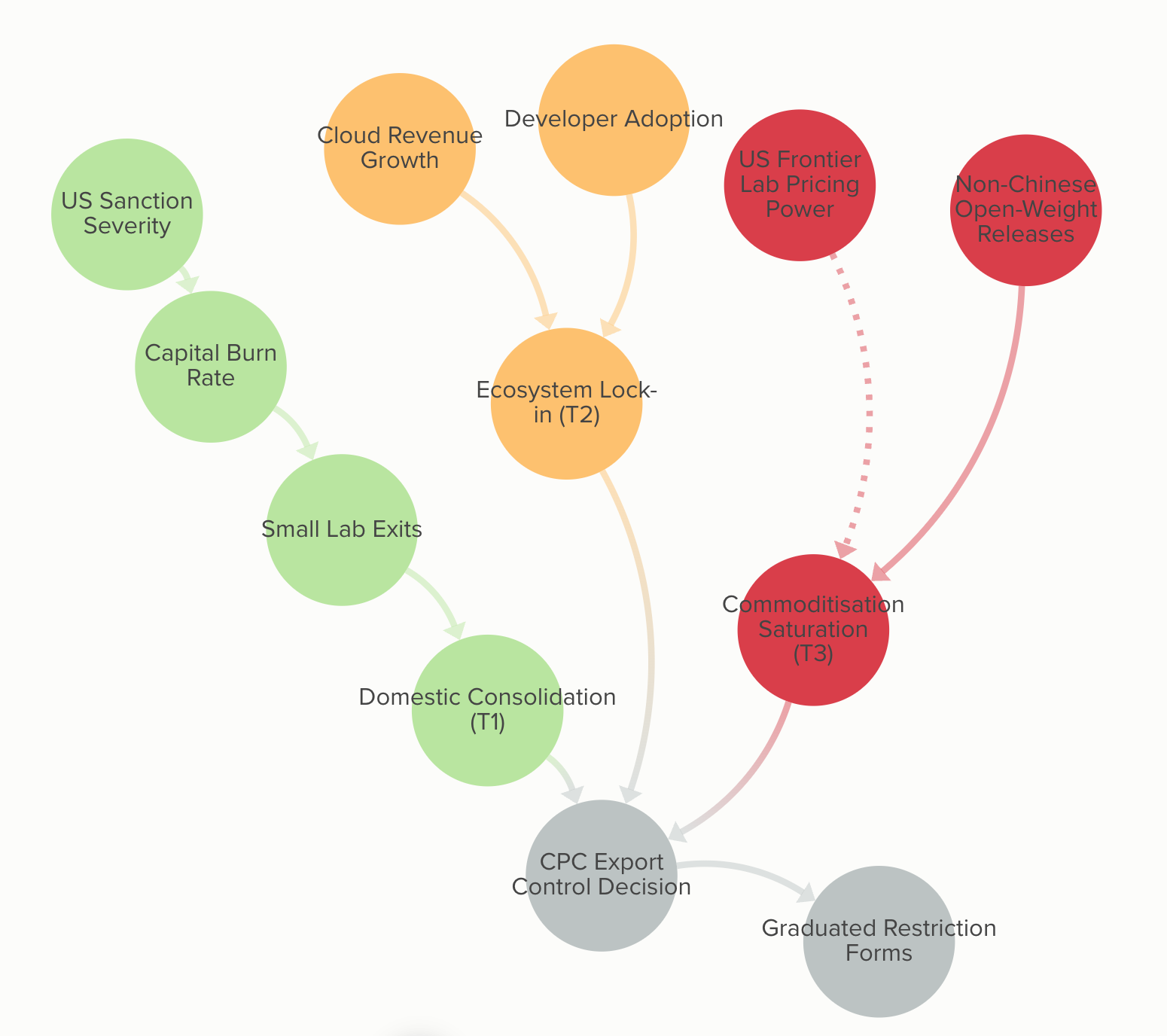
Combining the three thresholds suggests that graduated restrictions are most likely to begin appearing in late 2028. They might take the form of delayed releases, capability thresholds for licensing, channel-conditioned releases, and tiered access tied to diplomatic alignment.
What does this Mean for India?
For India, this environment presents both opportunity and strategic risk. Indian companies are already switching to Chinese LLMs to contain costs. The strategic imperative is to avoid lock-in to any single source—Chinese or American—while building domestic capacity in applications, industrial data, and domain-specific fine-tuning.
An underrated point is that even if China were to ban exports of its frontier models, the playbook is now public. Chinese firms have shown what can be done, and this strategy cannot be undone even if Beijing changes its stance. The genie is out of the bottle.
Matsyanyaaya: How Would the Makkah Pact Work?
Big fish eating small fish = Foreign Policy in action
—Pranay Kotasthane
On Thursday, Turkey, Saudi Arabia, and Pakistan signed the Makkah Joint Defence Agreement (MJDA), a trilateral collective-defence pact that declares an armed attack on one to be an attack on all. The Atlantic Council called it an inflexion point in the emerging multipolar order. Iran’s lawmaker Ebrahim Rezaei dismissed it as a “paper agreement.”
This pact is a direct fallout of American actions and non-actions in West Asia. My colleague Nitin Pai predicted this five months ago in his Mint column:
“This war is a watershed moment for how the Gulf Cooperation Council (GCC) countries see their security. They can now calculate the actual benefits and costs of the US security umbrella that covers them.
Despite asymmetry in military technology, Iran has been able to impose severe strategic costs on the UAE, Bahrain, Kuwait, Qatar and Saudi Arabia by exploiting economic asymmetry. Even if most Iranian missiles are intercepted above Arab skies, the psychology underpinning the Gulf’s prosperity has been damaged. And even if, as has been reported, the US did not prioritize Israel’s defence over that of the GCC states, the realization that it might do so is not lost on the region’s elite.
We should therefore expect some strategic reorientation, perhaps through a Gulf-led military alliance that might include Egypt, Turkey and Pakistan. The Pakistani military establishment will surely be rubbing its hands in anticipation of the rewards it can secure by offering both military manpower and nuclear weapons.”
With this pact in place, it’s worth analysing how it changes the calculus of other actors in the region. While every collective defence pact makes the same bold promise (we will fight for you), it is incredibly tough to honour that commitment. Pakistan, for example, has not supported Saudi Arabia in its fight against Iran to the extent of a NATO Article 5 partner despite there being a mutual defence agreement between the two states since September 2025. Thus, going beyond what the treaty might say, the reality depends on the network of existing relationships, existing military and economic capabilities, and limits imposed by geography.
Keeping these factors in mind, we built a simple model using Claude. In this model, each MJDA member has relationships with every relevant regional actor—allied, neutral, and adversarial. When a country X attacks MJDA member Y, the remaining members have to weigh their treaty obligation against the cost of fighting X given their own relationship with X, the pressure from X’s allies, and the physical constraints imposed by geography. Running every plausible attack scenario through this calculus, we saw two tiers of credibility emerge.
Tier 1: Iran and Israel
When Iran or Israel attacks any MJDA member, the pact is credible. Neither Iran nor Israel has a positive relationship with any of the three signatories that would create hesitation. Turkey, Saudi Arabia, and Pakistan would all oppose Iran or Israel regardless of MJDA’s existence. This tells us that MJDA adds no independent value in the scenarios it was ostensibly designed to counter. Against Iran, the treaty merely formalises what bilateral interests already support and nothing more.
Tier 2: India-Pakistan Tensions
When India attacks Pakistan, the pact faces a major test. Turkey’s relationship with India is frosty, and the cost of fighting India is low for Ankara. It is likely to accelerate its defence exports to Pakistan.
But Saudi Arabia’s relationship with India is close because of energy trade, a three million-plus Indian diaspora, and a carefully cultivated strategic partnership. Saudi Arabia would be sacrificing something vital to honour the pact.
Thus, in this scenario, Saudi Arabia would find itself in uncertain territory. It might limit its response to diplomatic support in response to the next round of border tensions between India and Pakistan. But if the confrontation escalates, the MJDA, at the margin, would change Saudi behaviour. From Pakistan’s perspective, MJDA serves to lock in Saudi Arabia’s economic commitment and Turkey’s defence commitment against India at a level that the bilateral relationship alone could not guarantee.
Military vs Economic Response
“An attack on one is an attack on all” implies a unified military response. In practice, each MJDA member’s response will be shaped by what it can do, not just what it wants to do.
Saudi Arabia’s military power projection beyond the Gulf is limited, as the Yemen war demonstrated. But its economic leverage over potential attackers—particularly India—is significant. Oil supply, diaspora workers whose remittances are a significant foreign exchange source, and sovereign wealth investment are pressure tools that can come into play. However, each is double-edged, as India has alternative oil sources and Indian diaspora workers are not easy to substitute.
A realistic reading of MJDA is therefore as a differentiated response pact. Turkey provides military capability such as drones and naval power. Saudi Arabia provides economic coercion and financial backing. Pakistan provides nuclear deterrence.
What this Means for India
India does not appear in the MJDA’s text, and Erdogan insisted the pact “is not directed against any country.” Regardless, the India-Pakistan scenario is the one where MJDA has independent analytical bite, i.e., the treaty changes the calculus in ways that pre-existing bilateral relationships do not.
For India, the MJDA formalises a Saudi commitment to Pakistan that makes economic coercion more likely. India’s strategic response should focus on reducing the economic leverage that makes Saudi Arabia’s participation consequential: accelerating energy diversification (solar, nuclear, diversified oil sources), deepening trade relationships with Gulf states that counterbalance Saudi influence (the UAE, Oman), and maintaining a diplomatic posture that makes an India-Pakistan military confrontation unlikely in the first place.
PS: You can see this interactive simulator which lets you run any attack scenario, adjust bilateral warmth scores, set the treaty commitment from “paper tiger” to “ironclad,” and toggle border vulnerability. Play with it and see the impact for yourself.
HomeWork
Reading and listening recommendations on public policy matters
[Fellowship Alert] The Network for Advanced Study Fellowship, offered by the Takshashila Institution, is accepting applications for the 2026-27 cohort. It is designed for those who want to develop serious, sustained work in their field. Fellows work on a research topic of their choice, with structured mentorship from Takshashila scholars and a network of domestic and international subject-matter specialists.
[YouTube Show] The next episode of our new show, Watching the Wheels, is up.
[Book] Here’s a review of a book that we look forward to reading. Bruno Maçães’ In Search of Greater India discusses the idea of civilisational states.
[Parliament Committee Watch Alert] The next tranche of parliament standing committee reports is up. Whatever your domain of interest in public policy, there’s always something useful you’ll find in these reports.
[Puliyabaazi] The last few years’ economic data shows a rise in employment figures but a fall in productivity. So we've Amit Basole decoding the reasons and implications in the latest episode.
The overdetermination finding is really useful, and I think Reason 5 is the most important: the digital loop feeding the physical loop China already dominates is a different claim from the usual "they're just distilling and dumping."
I notice a tension, though, between the analysis and your forecast. If the strategy is overdetermined, that is at odds with a datable phase-transition to restrictions in late 2028. Overdetermination, as I read your argument, means the outcome is robust because no single actor is steering it; the thresholds you identify (consolidation, lock-in, saturation) are real, but they describe conditions ripening, not a decision maturing. The "when will Beijing block" framing assumes a more unitary, more deliberate China than the rest of the analysis supports.
I think you also concede this point in the Reason-2-vs-4 discussion: state actors exploiting a structural dynamic they didn't create. If that's right, then open-weighting isn't a policy Beijing chose and can therefore withdraw on a schedule: it's closer to what a particular configuration of financial repression, provincial compute subsidies, a hundred-model war, and cloud-monetisation incentives generates. Deng's "feeling the stones while crossing the river" is the better image than a threshold model: not a plan with milestones, but a refusal to commit while the water is this deep and this fast. The stakes are high enough, and the technology's trajectory uncertain enough, that keeping the option open is itself the strategy.
None of which changes the India takeaway. However, I'd push it past "avoid single-source lock-in," which is the defensive half. I agree with RSJ's related point in his piece: leverage comes from making global firms immovably invested here — data centres, GCCs, local supply chains. That's the Reason-5 logic read from India's side. If the durable value in this technology is migrating to the infrastructure and physical-deployment layer, then India's opening isn't only to stay un-locked-in at the model layer; it's to become the ground that layer runs on. Dodging dependence is table stakes; becoming the ground it runs on is the prize.