

India Policy Watch #1: Mine or Yours?
Insights on current policy issues in India
—Pranay Kotasthane
Last week, another fiscal federalism debate surfaced. Naveen Patnaik, former Odisha CM, tweeted that the Mines and Minerals (Development and Regulation) Amendment Bill, 2026, passed by the two houses of Parliament earlier this month, would cause Odisha to lose ₹12,000 crore annually. Another mineral-rich state, Jharkhand, also opposed this move. The Union government soon brought out its side of the story through a Factsheet, and its ministers have been let out to do the defending. Since this technical issue is an important one, more so given the ongoing geopolitics of critical minerals, I am attempting an explainer that spans geopolitics, public finance, and federalism.
A quick disclosure before I begin. My bias is in favour of states having higher and more predictable tax revenue. It is not a bias in favour of states being free to set whatever tax rate they like, whenever they like. For the same reason, I also support GST. Higher revenues and freedom to increase tax rates are not the same demand. One can think states deserve a bigger, steadier share of mining wealth, and also think that the way some states have gone about claiming it (backdated, ad hoc, without notice to investors) has resulted in poor economic outcomes.
With that, let’s try to understand this issue in detail.
Background
For nearly seventy years, mining in India has run on a compromise. The Union allocates mining rights and fixes royalty rates. States collect that royalty and can tax the underlying land or mineral rights within limits. In July 2024, the Supreme Court’s nine-judge bench in Mineral Area Development Authority v. Steel Authority of India upended the “limits” half of that sentence. It held that royalty is a contractual payment, not a tax.
That unlocked for states an older, separate power to raise a lot more revenue from mineral rights and mineral-bearing land. If royalty counted as a tax, Parliament's existing occupation of that field might have blocked any separate state levy running alongside it. But now, states could levy new taxes on land. The Court said the Parliament could restrict this newfound power only where it concerned mineral rights, not land. A follow-up order allowed states to chase arrears going back to April 2005! Welcome back, retrospective taxation.
States moved quickly. Jharkhand introduced a Mineral Bearing Land Cess headed for ₹11,000 crore a year within two years. Odisha built a potential arrears claim exceeding ₹1 lakh crore. Then, earlier this month, Parliament passed the MMDR Amendment Act, which tries to roll back the Supreme Court's 2024 decision.
To help with understanding, I created a mineral tax “supply chain” table using authentic sources. Here is what that looks like. The row marked in red is the bone of contention.
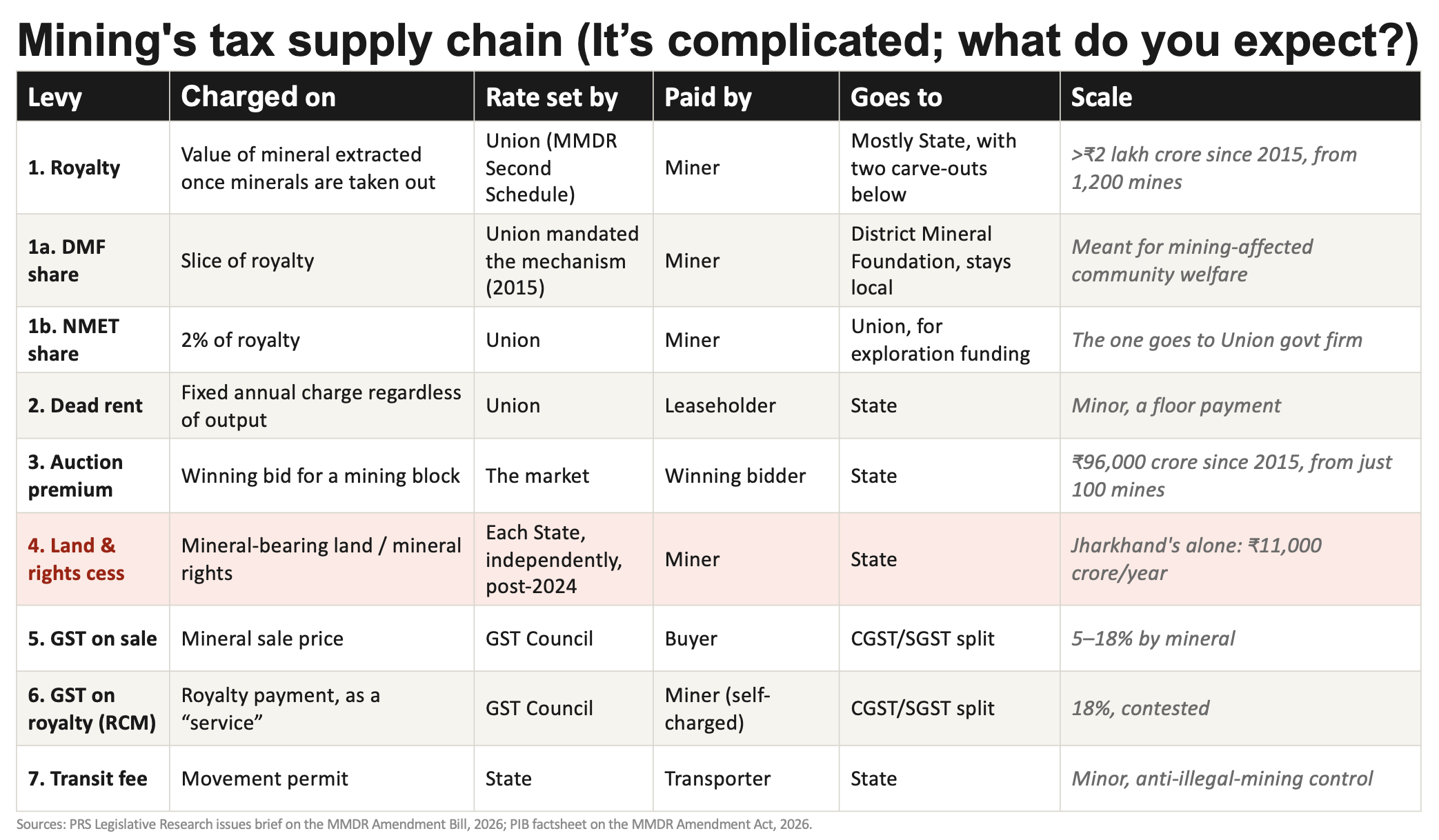
Now we can proceed to the changes brought by the 2026 Act. Alarmed by the 2024 judgment that led states to demand taxes on item 4 in the table going back twenty years, the miners would have petitioned the Union to bring in necessary changes. And given the weaponisation of supply chains, the Union had to act. That’s where this amendment comes in.
According to PRS Legislative Research’s legislative brief on the Act, the new law extends Union government control to “mineral-bearing land,” previously understood as a state land matter. And it bars states from imposing any tax, cess, or levy on mineral rights or mineral-bearing land, based on quantity, value, royalty, or otherwise, except under conditions the Union government prescribes. Dues that hadn’t been paid or recovered before the Act commenced are void. Dues already collected are not refunded. Royalty, auction premiums, and GST continue exactly as before. We can call this selective relaxation.
Just a diversion: this is a gem of a policyWTF. A retrospective taxation is being undone by a selective relaxation, one which is clearly a moral hazard. The Union is saying that if a miner already paid up to the state, it’s their bad luck. But if it hasn’t paid what was due, it will protect them. The effects are pretty similar to what happens when governments distribute loan waivers.
Getting back to the main plot, the Union government’s own factsheet on the Act says nearly 90 per cent of mining revenue already flows to states, so states have little to complain about. That’s true, and also beside the point. That figure is built from royalty (item 1 in the table) and auction premium data (item 3), two revenue streams this Act doesn’t touch. The actual fight is over the much newer stream: the mineral-bearing land tax that MADA opened up in 2024, and that Act now restricts (item 4). The factsheet does not mention the Supreme Court judgment that made this Act necessary in the first place.
So, How Do We Think About This Issue?
The Union’s framing treats this purely as tax simplification. That there were fourteen overlapping levies; some states were pushing land taxes as high as 20 per cent, and unpredictability was discouraging investment. It argued that fixing the multiplicity would get the investment back.
But that’s not the only consideration. Rohit Chandra, who has studied India’s coal sector deeply, opined in the Indian Express that the Act is the latest instance of the decades-long trend of dispossessing states of mineral wealth within their own borders. His strongest point is procedural rather than economic: the Act got five minutes of Lok Sabha debate, forty minutes in the Rajya Sabha, and no standing committee referral despite requests.
He also notes something that doesn’t fit a clean Government vs Opposition story. Several of the states hit hardest are currently aligned with the ruling coalition, which suggests fiscal centralisation as its own goal, not partisan targeting. His implicit fix, borrowed from China’s 1994 reforms, is that centralisation needs a compensating fiscal instrument for the states.
My colleagues at Takshashila, Sarthak Pradhan and Shobhankita Reddy, argue the efficiency case in this blog post. India’s mining levies resemble the pre-GST cascading tax structure, and the rates may already be past their revenue-maximising point. That would explain flat output and rising mineral imports better than any story about state greed. But they explicitly call the loss of state taxing power a source of concern, warn that unilateral action invites more litigation rather than less, and propose a GST-Council-style Minerals Council instead. They also cite CAG audits showing District Mineral Foundation money misspent in Odisha and Chhattisgarh, evidence that simply restoring state discretion isn’t automatically a complete answer either.
An Older Indian Mistake
There’s a domestic precedent for this kind of Union intervention. The 1956 Freight Equalisation Scheme (which we discussed in edition #206) subsidised the long-distance transport of iron, cement, fertiliser and steel so that every state paid the same delivered price regardless of distance from the mine. The stated goal was balanced industrial development. The actual effect, documented decades later by Firth and Liu, was the opposite. It pushed industries using these inputs away from the resource-rich east, Bihar, MP, Odisha and West Bengal, toward the west and south, erasing the locational advantage those states should have had. The damage was invisible for the first ten to fifteen years and only became stark by 1990, close to when the scheme was finally repealed.
The parallel to the MMDR Amendment is quite stark. Both are Union interventions that flatten a natural, geography-based advantage in the name of national uniformity. FES equalised the cost side, paying to erase the transport-cost edge resource states held. This Amendment restricts the revenue side, capping the fiscal edge those same states could draw from taxing their own mineral land. And the affected states are almost the same. It’s the same mineral belt being asked to subsidise the rest of the country for a second time.
What’s the Way Forward?
If we cut through all the legalese, there is a trade-off at the centre: higher economic activity vs fiscal federalism. Predictable, uniform mineral taxation supports economic activity as investment, exploration, and the downstream industries all depend on stable input costs. Tax rate freedom for states supports their ability to capture value from their own endowment on their own terms, without asking Delhi’s permission.
My priority is economic activity. A bigger, faster-growing mineral economy means faster-growing royalty and auction-premium revenue too - the streams that already go mostly to states. States that hold out for unrestricted rate-setting freedom on mineral land risk losing the main income stream itself. That’s the same logic behind supporting GST over unrestricted state VAT-setting. But taking that position means aligning the cognitive map of states that fear losing out.
I can think of three ways to balance these two objectives.
First, a negotiated Minerals Council, modelled on the GST Council, reaches the predictable tax-environment outcome by a slower route: weighted votes, qualified-majority decisions, and states with a seat at the table rather than a consultation exercise. A rate structure states sign on to is harder to litigate, harder for a future government to unilaterally reverse, and therefore more credible to an investor deciding whether to sink capital into a twenty-year mine plan.
Second, compensate the states losing ground, on a fixed clock. A GST-style transition guarantee, a revenue floor pegged to each mineral state’s pre-Amendment trajectory, funded for a fixed number of years while the Council and land cess start generating durable revenue on their own, could be a way out of this mess. Crucially, this compensation needs to come from general Union revenues, not from another cess on minerals, since the existing GST Compensation Cess already taxes coal, meaning Odisha and Jharkhand have already been funding part of the pool that cushioned other states’ GST transition.
Third, fix the two defects that matter regardless of which option above gets picked. The first one is resolving the selective relaxation-moral hazard problem with a uniform settlement, not a payment-date cutoff. The Union can apply one common ratio to every MADA-era claim, paid or unpaid, the way schemes like Vivad Se Vishwas already do. This removes the constitutional exposure and a specific source of investor uncertainty. Secondly, redesigning the land cess as a stable instrument for states is necessary because it is their constitutional right. Assessing it periodically on land classification or value, like ordinary property tax, instead of tying it to extraction volume or mineral price, could be one way forward. This would stop it from generating multi-year retrospective disputes and give states back a durable revenue instrument.
Unless these issues are sorted out, the Union government’s intent is unlikely to translate into the desired outcome of robust mining activity, something India needs desperately in this tough geopolitical environment.
India Policy Watch #2: What We’ve Got Here Is A Failure To Communicate
Insights on current policy issues in India
—RSJ
Central banks all over are having a communication problem, of late. It is an uncertain world out there with unending wars, shifting geopolitical sands, manic AI investment and, of course, Trump, making any prediction difficult. A central bank whose primary responsibility is price stability cannot have it easy in these times. I hope they aren’t yearning for some mythical good, old days when the central banks had it easy.
Because there was never such a time. Booms, busts, wars and mad kings have always been around. The task of maintaining sanity at the time of a boom, preventing a bust and making the economy boring has always been tough. To make things a bit easier for them (and to limit the possibility of having an egg all over their face), the central bankers have, over the years, evolved a patois of their own. They choose their words carefully, they hedge, and they obfuscate about their intent, and yet, they let the markets read their minds in a tango both perfected over the years.
Through this intricate dance of communication, the central bank would tell you what it was trying to achieve, give you an indication of how it would react when things changed, and then leave markets to do the rest. The government would worry about fiscal issues of spending and taxes. Bond yields and their movement would then let everyone know what investors thought about growth, inflation and the fiscal position. You could disagree about the future and bet against it, but there was a common language in which to have the argument.
But as I said, there is a communication problem afflicting them now.
The US is a good place to begin with to appreciate this. Kevin Warsh, someone who built his reputation as an inflation hawk, came into the Federal Reserve with the support of Trump, who thinks the US interest rate is pegged artificially high. So there was a question hanging over his appointment. Would the new chairman be independent enough to do what he thought was right, even when the White House wanted something else?
Even the harshest critics of Warsh don’t think him to be underqualified for the job. But he has a difficult balancing act to maintain. Do the right thing to ensure price stability while not rubbing Trump on the wrong side. He has therefore chosen an unusual proposition for a central banker. To talk less. Central banks like forward guidance because telling markets in a convoluted manner what they are likely to do reduces uncertainty. Warsh thinks this has gone too far.
The future is difficult to forecast, and in his own words, the financial markets react to the Fed’s comments, and the Fed, in turn, analyses the market to base its outlook for the future, turning this into a “hall-of-mirrors problem”. Better to look at the data, talk in generalities and allow markets to make their own assessment. As he said in his first press conference in July, market participants should “learn to play the ball, not the referee”. This is, of course, not correct because the Fed is a huge market player itself and not some kind of neutral referee alone. The bond yield reacted to his July speech with the curve steepening the most since the last 12 months. But Warsh remained steadfast in his view about the Fed’s communication approach. It will speak less.
His debut Jackson Hole speech on Friday therefore was widely anticipated to toe a similar line. He surprised to a large extent by going back on his earlier commitment to speaking in generalities. He did not provide guidance, however, he did make it clear that inflation is a problem. From CNBC:
“We must be confident that underlying inflation is moving to our objective, clearly and at sufficient speed. Otherwise, we have work to do. That’s our job ... our mandate ... and our charge to keep.”
Expectations of a rate increase in September went up, and short-term Treasury yields moved higher (the curve flattened).
While Warsh is trying to rework the monetary policy communication, he has not been helped by the Treasury Secretary, who has been on a different trip in the past few weeks. The 30-year Treasury yield has moved to 5.2%, and long-term borrowing costs have risen as investors worry about inflation, the fiscal deficit and the amount of debt that the US government has to issue. The Treasury has decided that it will fight the bond market and try to keep the yield down to help with the cost of interest on a total debt that has now crossed $40 trillion. It has been up to all kinds of unusual moves in the past month, starting with coordinated buying of over $90 billion of Japanese Yen with Euros from its reserves to ensure the Japanese central bank doesn’t sell off US bonds to rescue the Yen from its lowest point in the last 40 years. A further falling Yen risked more downward pressure on other currencies of large EMs, who would have sold more dollars, sloping the yield curve further upwards.
So, Warsh is pontificating on how participants should go by unfiltered and uncorrupted signals coming from the bond market while Bessent is manipulating the same market as much as possible. The Treasury is not just managing liquidity; it is also trying to fix the price. And once a government starts doing that because it does not like the signal coming from the market, it develops a taste for it. This is why you find the phrase fiscal dominance now starting to appear in the media. I would not say that the US has reached a state of fiscal dominance. But the underlying issue is real. Fiscal dominance over monetary policy is a recipe for disaster waiting to happen.
India is facing a less dramatic version of this communication issue.
The press meet after the RBI’s MPC meeting on August 5 suggested that the RBI was not particularly worried about inflation getting out of control. There was a clear dovish tone to the commentary. Growth had held up reasonably well, and the inflation forecast was manageable. The natural conclusion was that the RBI was comfortable waiting for more data before doing anything and the market responded by pushing out a possible rate cut further into the future. I wrote about it here, saying this stance doesn’t make a lot of sense given the variables involved and the spread between the US and India rates, which is the lowest it has been for a long time.
Last week we got the detailed minutes of the MPC meeting. The whole commentary now stood on its head. While all six members had voted to keep the repo rate at 5.25 per cent, the minutes showed a committee that was much more alert to inflation risks than the press conference had suggested. The members had talked about oil prices, the rupee, global uncertainty and the possibility that supply-side inflation could become more persistent. The distinctive tone was that inflation will go beyond 5 per cent and remain sticky. This was a hawkish about-turn in communication that no one saw coming. This hasn’t happened before, where the two-week gap between the MPC meeting and the minutes could completely change the tone of what was being said. The benchmark bond yield moved higher after the minutes, reacting to the revised tone.
Then we had the FCNR(B) communication last week, which makes the same point about communication. The RBI introduced a concessional swap window in June to encourage foreign currency inflows into India. Banks could offer better rates to NRIs bringing FCNR(B) deposits into India because the RBI was effectively taking on the currency risk through the swap facility. The scheme was meant to run until September 30. At the same post-MPC press conference, the Governor was asked whether the RBI was considering closing the facility early. His answer was a clear no. At that point, banks had already mobilised nearly $41 billion under the facility.
Nine days later, the RBI announced that the facility for fresh FCNR(B) mobilisation would close on August 31.
To be sure, the response had been better than expected. By August 21, the total inflow associated with the measures had reached about $73 billion. Perhaps the RBI had achieved what it wanted. But it does beg the question why couldn’t a broad target be set upfront that could have Banks plan better and investors work to that timeline. Policy credibility at the operational level is about being consistent with communication and leaving the element of surprise to a few isolated cases.
The ECLGS 5.0 episode is similar. The government had created a ₹2.55 lakh crore guarantee scheme for MSME lending after the West Asia shock. The scheme was formally available until March 31, 2027, subject to the guarantee allocation being exhausted. The entire amount was used by August 20, and the scheme closed.
Banks were left with loans that had been processed or sanctioned but could not necessarily be disbursed under the guarantee. Again, the government had an entirely valid explanation. The scheme had run out. But many MSME owners who don’t look at the total amount the system has processed (they have other things to worry about) and time their borrowing decisions have been left in the lurch. It is not like the West Asia crisis is resolved already. In fact, I will argue that things will continue to be bad on the crude oil front and eventually the input costs will start hurting MSMEs in India. Many of these companies typically build up their inventory post-monsoon and in preparation for the festive season. That’s when they would have needed working capital support. But that scheme is gone now overnight with a single announcement.
The problem with policy change and communication, both in the US and India, to my mind stems from a similar source. The RBI is dealing with inflation, growth, the rupee, capital flows, banking liquidity, government bond yields and financial stability. Governments everywhere are dealing with energy prices, trade restrictions, geopolitical shocks and elections. The central banks are trying to influence too many variables at the same time because they seem to be compensating for the lack of a coherent fiscal policy that takes hard calls. Monetary policy tools will continue to get more complicated and their communication will get more entangled in trying to help the fiscal.
The recent experience of the central banks should make them wonder that in a world where policymakers cannot predict much, can they keep their hold over monetary policy issues independently and at least make their own rules predictable enough for everyone else to plan?
HomeWork
Reading and listening recommendations on public policy matters
[Book] Fiscal Fables is now available in your neighbourhood bookstore and on Amazon. Buy, read, gift :)
[Playground] What if I told you that you have a public finance playground to yourself? You can upload state budget documents, analyse past data, and see where your income tax goes. All this and more is coming up on this portal.
[Puliyabaazi] We have an in-depth discussion on whether UPI transactions should be free. Give it a listen.