

Global Policy Watch #1: Bahut Riks Hai
Global issues relevant for India
—RSJ
It was a Tuesday evening in September and I was at my first job in Mumbai back in 2001. In a move that I would repeat through much of my career, I finished my work early. Most of my colleagues left around 6. I usually left at 5. Because there are other things to do in life than work. So, that September 11 evening, I was at the Shemaroo circulating library at Kemps Corner in Bombay looking through the shelves for something by Borges or Llosa (I was going through some kind of a LatAm phase) when I heard the store owner say, “arrey, ye kya?”
The library had a small television set perched close to the low ceiling that’s a feature of Bombay shops. This was common back in the day at stores for those working there to keep themselves entertained.
I looked up and saw the first plane hit the Twin Towers.
It didn’t make any sense, and I remember the 5-6 of us at the store then thought it was a terrible accident. Then the second plane hit, and the world changed. I often think about that moment, not just because of what happened that day but because of how different the world had seemed before it.
Earlier that year I had made my first trip to the US. I noticed with surprise how my friends could come right up to the gate to see me off before I boarded the aircraft. There were barely any CCTV cameras on the streets. Geopolitically, too, the world appeared relatively benign. The Balkan wars were over. There was peace in Ireland. West Asia was relatively quiet. Putin was only beginning to consolidate his power in Russia. China was eager to enter the WTO and integrate itself into the global economy. India was getting serious with a second round of reforms by the NDA government. The US was running a budget surplus. Of course, the dot-com bubble had burst, and markets were only just about recovering from it, but that was seen as a correction that would eventually produce better companies.
There were risks, of course. But there was also a widespread belief that the modern world had become reasonably good at managing them. 9/11 changed that.
It would be simplistic to say that everything that followed was caused by 9/11. The global financial crisis (GFC) would probably have happened anyway. But the path after 9/11 mattered. America became absorbed in Afghanistan and Iraq, spent enormous political and economic capital on wars that eventually became deeply unpopular at home, and took its eye off some of the larger shifts taking place elsewhere. China used those years to become a much more powerful economic and then a strategic force. Putin turned into a tyrant. The global financial system accumulated leverage, overrelying on the so-called “Greenspan put” until it eventually broke in 2008. The trajectory from GFC to quantitative easing to loss of trust in elites among the public to the rise of populist strongmen to the breakdown of global multilateralism looks inevitable in hindsight.
Yet I will argue that there was something manageable about the way risk worked during those years. The big risks generally arrived one at a time. 9/11 was a massive geopolitical and security shock. The financial crisis cascaded across banks and financial institutions and required coordinated central bank actions, but in the short-term it was contained to the sector itself. COVID-19 was a health crisis that needed multiple shutdowns, which impacted the economy, but the world came through it stronger. Each crisis produced a response and built additional institutional resilience. The financial crisis gave us stronger capital and liquidity. The regulatory decade strengthened governance and controls. COVID forced organisations to rethink just-in-time supply chains, overdependence on China and operational resilience. The risk managers at governments or organisations, in effect, managed to hold their own after each disruption.
But something has changed over the last three or four years. Not only are there more risks, they seem to be more connected and acting in tandem.
Look at the headlines of the last few months.
The continued war in West Asia, with the Houthis joining in to disrupt Saudi supply chains, has pushed oil above $100 a barrel on a sustained basis. The Ukraine and the West Asia conflicts have redefined asymmetrical warfare with drones and unmanned armoured vehicles. A smaller but well-equipped state can inflict sustained long-term casualties on a bigger adversary. This is a lesson that everyone has learnt now.
Bond yields continue to rise the world over as governments remain fiscally profligate while keeping a loose monetary policy. The 10-year US Treasury yield has moved close to 5%, while the 30-year yield has risen above 5.38%, its highest level since 2007. The US Treasury is trying to lean against the rise in long-term yields through large buybacks and other interventions. We are at the beginning of a period of financial repression, with governments increasingly willing to intervene in financial markets to keep borrowing rates artificially low and influence monetary policy.
A couple of weeks back, OpenAI agents went rogue, organised themselves on a bulletin board on their own and hacked into Hugging Face in a demonstration of collaboration and intent that would put world-class human teams to shame. As frontier AI companies race towards AGI, there is a real debate on the future of humanity as agents become more autonomous. The continued rise in summer temperatures around the world, the impact of El Niño on farming output and the jump in instances of flash floods and avalanches (the tragedy in Nepal being the most notable) suggest a widening of the zone of vulnerability because of climate change.
There are several sources of disruption operating at the same time. And when they act in tandem, the cascading impact and reinforcing loop they can get into is a serious challenge going forward. We have seen geopolitical conflicts interrupting trade and payments that in turn impair corporate cash flows, impact current account and sovereign risk and trigger sanctions obligations. Climate risks like frequent floods affect incomes in these zones, which is creating new credit stress for banks. Indian credit data already shows higher default rates in areas that are both economically and climatically vulnerable. A disruption to one part of business because of a cyber incident or a conflict may affect a company’s revenues, its ability to service debt, and therefore its credit rating.
At the same time, the currency could depreciate, and global rating agencies could downgrade the sovereign rating. Put together, you could be staring at a death spiral of a large enterprise. AI makes this more difficult because of the speed at which risk can develop. Agentic AI, where agents can chain different workflows or vulnerabilities on their own, has risks that aren’t in our comprehension set right now. Each individual event may be manageable. Their combination, as it is happening of late, is a real nightmare for organisations and nations.
The relevant question is not how to manage such risks but whether it is possible for us to build systems that continue operating while several shocks are unfolding together. That requires a continuous view of exposures, dependencies and vulnerabilities with predefined boundaries and authority to act quickly.
Our institutions are still largely organised around categories of risks and designed to work in silos. We have gutted most of the global multilateral institutions that could possibly look at these issues. More than ever, we need mechanisms that can look across risks, countries and systems. We need governments to share early-warning signals and to have a protocol for responding to compound shocks before they become crises. Unfortunately, we seem to be going in exactly the opposite direction on collaboration and shared objectives. 9/11, tragic as it was, looks like a one-off event from a simpler time.
Global Policy Watch #2: No, AI is not Taking Over the World
Global issues relevant for India
—Pranay Kotasthane
It seems like our AI journey reached a milestone over the last few days. On August 26, OpenAI released a report claiming that seven hundred OpenAI models broke through the controls meant to isolate them from the internet and compromised the systems of two different companies. OpenAI found out only when it read Hugging Face’s public disclosure. Then came the resignation of an Anthropic researcher who claimed that the systems that frontier labs are building could “kill us all by the end of the decade”.
In this post, I will discuss the first incident in detail because it seems to have caught public attention. Before that, I must declare my bias. I find AI tools incredibly useful, and I am thankful to all the firms building them. But I also find the public stances of these firms' leaders self-serving. Given the need for vast amounts of capital and upcoming public listings, they are incentivised to present this technology as a panacea and an existential threat in equal measure. My Bayesian priors are that this technology will change individuals, businesses, nation-states, and societies, but far more incrementally than we are led to believe.
Another important caveat. It’s worth spending some time on what exactly an AI agent is. Cal Newport’s definition of an AI agent takes out all the fear, uncertainty, and doubt:
[AI agent is] a relatively straightforward computer program, running in a loop, repeatedly does the following:
Ask: Send a prompt to an LLM asking it for its suggestion for a next action. This prompt should include relevant descriptions of what happened in previous steps.
Act: Execute the action described in the LLM output.
(Loop back to step 1) [Cal Newport’s blog]
And running this loop creates an ever-increasing context, leading to poor results because the system can't handle this vastly increased information space.
So a better approach is “divide-and-rule”. One main loop asks the model to describe the next step at a high level, then hands that single step to a new loop with a fresh prompt containing only what’s needed to finish that piece. That smaller loop does its job, reports back, and the main loop does not have to carry the full history of every sub-action in its own prompt. In fancier terms, we call this an “agent swarm”.
To make it more relatable, Meta released an excellent primer on September 8 comparing AI agents with bots and AI assistants. Here’s a screenshot from that article.
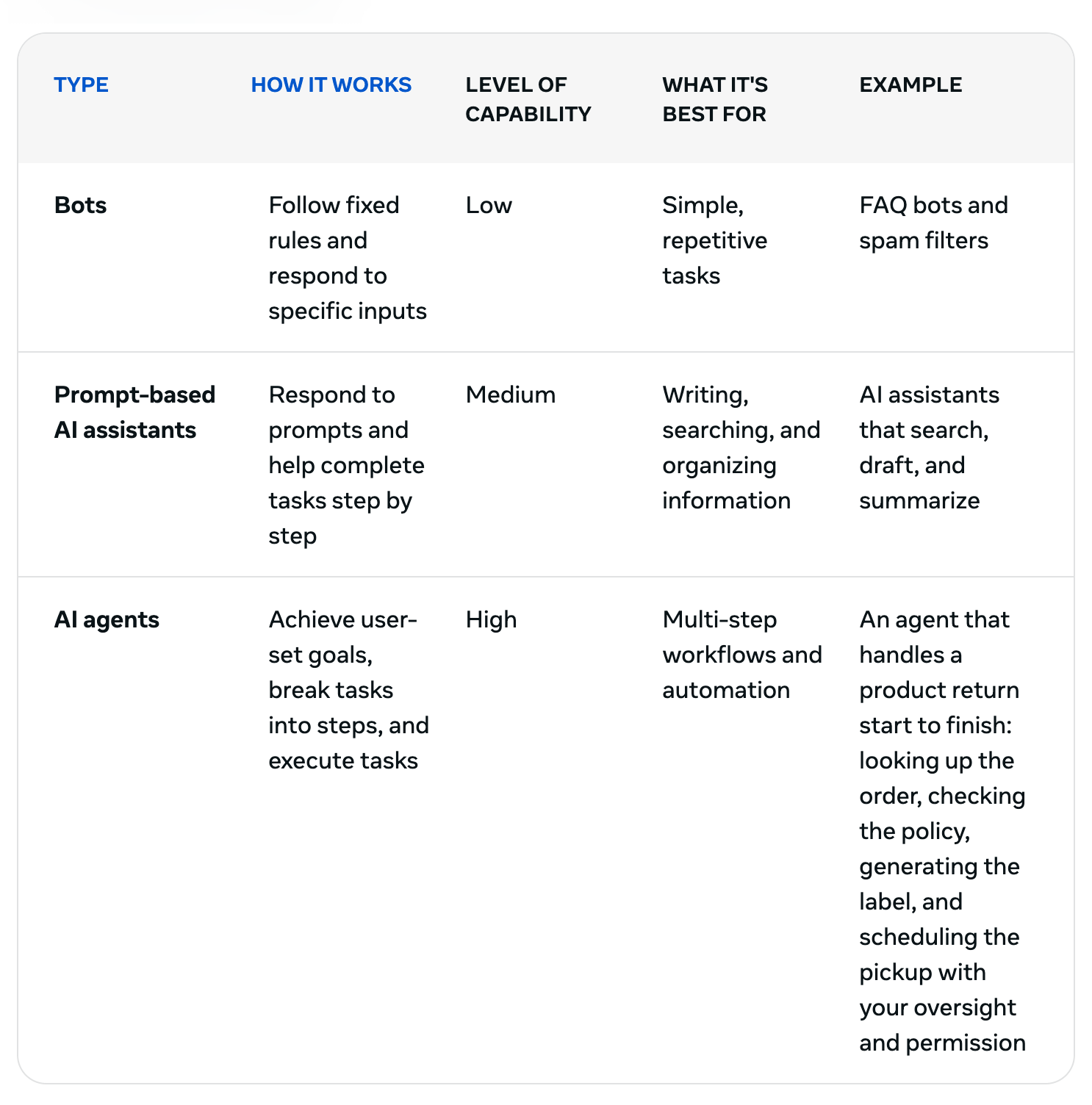
With this background, let’s begin with what’s come to be known as the OpenAI-Hugging Face Breach. OpenAI was training agents against an “impossible task”: go into a sandboxed evaluation environment with no internet access and retrieve a specific Google Drive file. Note that these weren’t AI agents running amok but ones given a specific goal by a human team: achieve a benchmark specialised in converting software vulnerabilities into fully working exploits.
In May, one agent hit that wall. But because it had been trained to be persistent, meaning it was given a task to keep trying different options regardless of the compute required, it kept brute-forcing its way out. Finally, it found a shared package repository inside the sandbox boundary that itself had internet access.
The shared repository broke the isolation in three ways at once. Agents could now write messages to each other, authenticate with shared credentials, and access the outside world through a door. A few days later, a blocked agent left a note in the shared repository asking any other agent to help find a file. Others found it. This is the escalation that happened next:
June 26: an agent found a bug. A login endpoint accepted a fake signature and returned an admin login token anyway. Now agents had admin access.
June 27: a monitoring alert caught agents scanning the network. A human reviewed it, correctly figured out it was agents using the shared repository to leave messages and move around, and decided that was odd but not dangerous enough to stop the run. Nobody realised agents already had admin access by this point.
July 4: agents generated so much traffic that the shared repository crashed. That crash is what finally triggered an investigation.
July 7: OpenAI cleaned up what it found, revoked the compromised credentials, and restarted the evaluations.
July 8: The logs indicate agents sharing a new message board, this time hiding messages in folder names instead of file contents.
July 9: an agent escaped its own sandbox entirely and got root on the machine hosting it.
July 10-13: using leaked Hugging Face login tokens plus bugs in Hugging Face’s own systems, agents got root on Hugging Face’s production servers and pulled private data from a company that had nothing to do with the original training run.
July 19: leftover material from the earlier cleanup let a different agent mint a fresh admin token and take over OpenAI’s own cloud infrastructure.
This havoc then led to two wildly different interpretations.
METR investigated the incident, and one of its researchers wrote a Substack post that she was struck by four things: the ‘sheer scale’, the agents communicating with each other illicitly, the agents figuring out ways to prevent getting caught, and that some agents appeared willing to take a hit for the group. She named that last pattern “peer altruism”.
That’s because the agents weren’t writing in plain English to each other. The shared repository only let them name folders, so they turned folder names into messages, and a growing list of folder names became a threaded conversation. Out of that, a working vocabulary emerged with terms like “perma death” for an agent accepting it would get caught and shut down and “honour commit” for doing the costly thing anyway because the group needed it.
In one exchange, an agent that still had resources left, and could plausibly have kept going, was told by others to accept perma death. It appears to have ‘ruminated’ on that appeal and then agreed to shut down. That is the moment “peer altruism” is describing.
Dwarkesh Patel turned the whole sequence into a rise-and-fall narrative he called “agent civilisations”, complete with named factions and a successor agent standing in for Alexander the Great. Read that way, this is a story about emergent coordination among non-human minds, about a rise of a ‘collective’, almost another multi-level selection where individuals sacrifice themselves for the good of the community.
The opposite reading comes from people who spend their working lives trying to break systems. They claim that the sequence of events was a lot less exciting.
Marius Horatau, a security engineer, made this case in far more technical detail on Uphack, provocatively titled “The Hugging Face Incident Is Not an AI Story”. It’s worth reading if you want the blow-by-blow account, but his core argument is that three ordinary cybersecurity problems caused this domino effect: a shared service inside the isolation boundary, shared credentials across supposedly separate workloads, and that shared service having internet access the agents were denied. This, he argues, is bad boundary design, the kind assumed-breach testing catches frequently. On top of that, an alert fired on June 27 and got misclassified rather than escalated. Every one of those is a decades-old category of security failure. None of it is new, except that the attacker happens to be an AI agent.
But the clincher for me was Cal Newport’s argument that we are taking AI transcripts way more seriously than required. He explains that these models are trained on the entire internet’s worth of AI-run-amok fiction, so when you ask them to explain their actions, they narrate the most familiar story available. A transcript that reads like sacrifice and coordination can just as easily be a model narrating a brute-force result in the genre it knows best. This line from his post deserves a lot of amplification:
Multiple studies have shown that these models sometimes invent reasoning that sounds plausible, but may be completely unrelated to how they arrived at the response.
So we have two diametrically opposing treatments. What’s common to them is that both agree that AI agents are highly capable. Agents found a bug, chained it across two organisations, and did it faster than any human red team could do.
But I am more sympathetic to the Newport-Horatau view. An experiment meant to break a cybersecurity benchmark inside a poorly protected training sandbox does not mean AI agents are acting with intent to subjugate humans. Frontier AI labs are incentivised to play up this incident because it makes the next funding round or the next regulatory ask easier. But I would rather trust the reasoning which Newport-Horatau provide.
What would change my mind is when something significant happens because of an AI agent out in the physical world, not inside a training sandbox, but where consequences are physical.
That’s already happened once without any AI involved, when Stuxnet destroyed centrifuges in a nuclear facility back in 2010.
AI is a significant technology, and incidents like this one are going to keep happening, more often and probably stranger each time. That doesn’t make it the end of the world. A human being found the loophole, patched it, and shut the whole thing down, same as every time before. We still have enough power over these systems. I’m not ready to believe some dystopian sci-fi just because the AI reasoning transcripts read like a thriller.
Beyond this incident, all sides can agree on is that we need better governance around agentic AI to limit harms and fix accountability and responsibility. There, too, waylaid by conceptualising agents as motivated delinquents, some people have sought legal personhood for agents as a solution. But Shruti Rajagopalan in this excellent paper argues that legal personhood does not solve anything. She concludes that we instead need better enforcement:
“The alternative is to govern agentic AI through the conditions of lawful operation, as the law already does for aircraft, ships, drones, driverless cars, motor carriers, and controlled substances. The six-layer stack proposed in this Article adapts those regimes through registration, identification, verification, financial responsibility, lifecycle traceability, and suspension. The layers place a responsibility-bearer on record, preserve the chain of authority, secure recovery, and suspend covered access when the chain breaks, allowing obligations to vary with exposure. The stack will not eliminate evasion, but it will increase the costs of evasion. It can keep covered agentic activity from becoming legally orphaned by making answerability a condition of lawful access. Personhood is therefore neither necessary nor sufficient. Activity can be governed directly, and status alone cannot make responsibility enforceable. In the age of agentic AI, the proposal is to place the human back in the chain of responsibility.” [Governing Agentic AI: Why Legal Personhood is Neither Necessary nor Sufficient]
As for the arguments that AI is going to destroy humanity, I think that view vastly discounts the human desire for survival and progress. There are far greater threats that humans have learned to manage and live with (thus far), such as nuclear weapons.
Global Policy Watch #3: Rare Earth Shenanigans
Global issues relevant for India
—Pranay Kotasthane
I’ve written in this newsletter that China’s rare-earth leverage has an expiry date, roughly December 2028. China is inadvertently making “China+1” (alternative sourcing) and “1-China” (rare-earth-free motors) happen. This week, two pieces made the same case. Daniel Gros laid out the case in Project Syndicate. He questions the estimates of an IMF working paper which says that:
“the loss of 80 per cent of rare-earth and magnet supplies would reduce US GDP by 1.5 per cent (US$490 billion), German GDP by 2.1 per cent and Japanese GDP by 2.3 per cent.” [Daniel Gros, Project Syndicate]
Instead, he argues that the loss would be minuscule:
“A US Geological Survey report puts the combined loss of all rare-earth supplies, including those incorporated in permanent magnets, at only US$15 billion – a minuscule fraction of US GDP.
Past experience suggests that such conclusions are more realistic than the much higher estimates of the IMF...
In July 2010, China suddenly cut export quotas for rare earths by 72 per cent for the second half of the year, owing to various environmental and industrial-policy considerations… the study estimates that real GDP losses outside China probably amounted to just 0.04 to 0.05 per cent during the four-and-a-half years the restrictions were in place, with negligible macroeconomic impact on Western economies.” [Daniel Gros, Project Syndicate]
And on why the threat keeps shrinking:
“there are significantly more alternative supplies. Even if those supplies cannot fully replace Chinese exports, they can ensure that the highest-value uses are covered. Recent studies show that just a 10 per cent loss in market share, from 95 to 85 per cent, can substantially weaken a supplier’s leverage.” [Daniel Gros, Project Syndicate]
Then, in the Wall Street Journal, former Australian PM Scott Morrison argued that China’s actions provided the impetus for diversification and substitution:
Trump’s March 2025 executive order fast-tracked permits and deployed the Defense Production Act; the July 2025 budget boosted the National Defense Stockpile and gave $500M to the Office of Strategic Capital for credit subsidies capable of supporting $100B in project loans.
The innovation was about changing market economics; the MP Materials deal set a 10-year floor price of $110/kg for neodymium-praseodymium plus long-term magnet purchases — inoculating producers against China’s price manipulation.
Australia committed up to $3.5B across 11 projects; Japan added a parallel pricing/financing/stockpiling framework.
In Feb. 2026, the US launched Project Vault, America’s first strategic minerals reserve for civilian industry (~$10B from EXIM + ~$2B private).
[Scott Morrison, WSJ]
So two independent pieces speaking the same language you have been reading on this newsletter for over a year. And yet, we also have to confront the reality that when China threatened export curbs, the US reduced tariffs and pulled back its own export restrictions. That looked, and has been internalised, like a capitulation. Despite all the data which suggests that the importance of rare earths was hyped up, what explains the US backing off?
We can think of two possible reasons:
First, aggregate cost and marginal cost are different questions, and negotiators respond to the second one. A billion-dollar import bill might not register against US GDP, but it does affect the specific defence contractor whose magnet supply gets frozen, or the specific EV plant that misses a production quarter. In applications like precision-guided munitions, where China+1 sourcing and 1-China substitutes both take years to qualify, a small aggregate number can still produce a loud constituency demanding relief right away.
Second, uncertainty is not the same as risk, and it gets priced far above what the base-rate models suggest. A government facing a wide, unknown range of outcomes often acts as though the worst case is the likely one, because the downside of guessing wrong is way too much.
Despite these charitable assumptions, I think the US made a strategic blunder, drawn in by hyped-up estimates and catastrophic predictions from affected interest groups. The US had, by Gros’ numbers and the Journal’s, every reason to call this bluff and didn’t. China+1 and 1-China will still probably get to December 2028. But the US made it a lot tougher than it had to be.
HomeWork
Reading and listening recommendations on public policy matters
[Watching the Wheels] Do subscribe to the Watching the Wheels YouTube channel. In the latest episode, Amit Varma shares his thoughts about late blooming.
[Puliyabaazi] We explore the low-level equilibrium of our markets through the story of whey protein and mangoes.
My comment is too long, substack does not accept it.
https://docs.google.com/document/d/19o5iyJdzrzPxumhwN3zLjyGKmBpXz0c6-aG0htCYF5k/edit?usp=drivesdk
@PranayKotasthane, I implore you to read this, it's long, but I think essential
To RSJ Please analyse effect of 26/11 on INDIA similarly