

Global Policy Watch: Charisma Ka Karishma
Global issues relevant to India
—RSJ
There are two scenes from Hindi cinema that I go back to when I think about charisma. The first is from Vijay Anand’s Guide, based on R.K. Narayan’s novel of the same name. Raju Guide (Dev Anand) has just finished his prison term and he walks away into the yonder (with Dada Burman singing Wahan Kaun Hai Tera Musafir in the background). He falls in with a group of sadhus and reaches a small village where he spends the night in a temple courtyard. In the morning, the sadhus depart, and one of them puts his religious shawl over the sleeping Raju. A villager arrives, sees the man in the shawl and mistakes him for a holy man. From there, the story takes on a life of its own. Villagers begin attributing qualities to Raju that he never claimed to possess. He could cure things, solve problems, perhaps perform miracles. Soon the village is facing a drought, the villagers believe that if Raju fasts for twelve days, the rains will come. He does, he dies, and the rain arrives.
The other scene is from Mani Ratnam’s Iruvar, a thinly veiled version of the birth of the Dravidian movement and the lives of MGR and Karunanidhi. Annadurai is on his deathbed and the question is who will inherit the movement. Karunanidhi (or his likeness, played on screen by Prakash Raj), the firebrand poet whose words have roused the masses, assumes that the answer is obvious. He has put in the hard yards for the ideology. MGR (a mesmerising Mohanlal on screen), is a star who is on the ascendant and who has been brought into the political fold because his friend Karunanidhi and Annadurai see something in his popularity. Annadurai chooses MGR and a disappointed Karunanidhi takes MGR with him onto a terrace where a crowd is waiting below. MGR is unsure of what to do. Karunanidhi raises MGR’s hand upwards to the sky. The crowd erupts. What is interesting is MGR’s face. Until that moment, he knows he is popular. In that moment, he sees something else. He sees what the crowd sees in him. He eases, waves at the crowd and soon has them in his thrall.
That’s the one defining thing about charisma. It lies in the eyes of the beholder. Weber, who wrote extensively about charisma more than a century ago, defined it in a similar vein. Charisma is a quality attributed to an individual who is regarded as possessing exceptional, even superhuman, qualities. What matters sociologically is not whether those qualities exist but how followers perceive them. Recognition is the key here.
It is unsurprising, therefore, that charismatic people do not know they possess it to begin with. The attribution comes first, and the consciousness of it comes later. A crowd of followers sustain it till the person starts understanding the crowd’s belief and begins to act within that space. Both Raju Guide and MGR were instances of this.
Charisma fills a vacuum in a society. Its need isn’t felt in a milieu that is comfortable with its existing arrangements. It appears when there is a felt need for change, a crisis, or a moment when extant institutional mechanisms appear inadequate. People begin looking for a leader who can do something beyond the normal course. Weber called it the mission of the leader. The leader’s claim succeeds so long as the followers recognise the mission and the leader continues to prove himself. As Weber put it, the charismatic claim breaks down when the mission is no longer recognised.
I am thinking of charisma again as I take in the events of the last few days. PM Modi turned 76 this week, and the BJP used the occasion to mark his 25 years in public life. The party organised the Aashirwad Ka Diya campaign, with lamp-lighting events across the country, alongside a month-long Seva Sankalp Abhiyan. The BJP has a certain genius for these things, and PM Modi has often turned the mundane into something extraordinary (remember the thali-banging people did to drive Coronavirus).
I was out and about on the evening of Sep 17, and I barely saw a diya lit at the homes of people. That didn’t stop the sycophancy of the mainstream media or the competitive spectacle around the country with ministers, CMs and random BJP functionaries participating in increasingly elaborate displays of Modi bhakti. PM Modi later thanked people for the gesture and said it had deeply touched him. But this didn’t generate the passion of similar Modi symbolism of the past. There were significantly more negative comments on social media about these displays and the increasingly cringe content put up in trying to keep up with Gen Z.
As the BJP and PM Modi will realise, you cannot organise charisma. A rally, an inauguration or a song can be created to gather the masses. But the thing that makes a leader charismatic is the spontaneous attribution of qualities by the followers. Once you try to manufacture the evidence of that attribution, you have already lost charisma.
So, what has changed?
In edition #86, I had written about the origin of Modi’s charisma. Back in 2013-14, two different anxieties within the electorate came together. There was the accumulated frustration with the performance of UPA 2, with corruption and policy paralysis. There was also a cultural discomfort among a section of the majority with the way the Indian state had evolved, particularly around questions of Hindu identity, secularism and nationhood. This was both real and imagined, like most things. The two things had different origins, but they converged politically.
Modi, through a coming together of happenstance and deliberate actions, became the person into whom both these could be projected. With the combination of “Gujarat model” and Hindu hridyasamrat woven into his persona, he came to embody the possibility of a different India. There was some track record of performance (not directly experienced by most people outside of Gujarat) and a sense of mystique that has long followed public personalities in India who don’t have a family. This allowed a wide spectrum of people to pour their aspirations, grievances and hopes for the future into him.
For the last decade, that charisma has allowed PM Modi to transcend the usual metrics by which governments are usually judged. A report card of all the promises made just in his Independence Day speeches over the years and the actual performance on those will make his delivery record clear for anyone interested. The government could be criticised on roti, kapda and makaan issues and still retain the ability to say that it was changing the country in a more fundamental way. The construction of the Ram temple, the revocation of Article 370, changes in history books, CAA et al. became markers of that change for his supporters. Each such act provided another proof of the original mission and so the charisma sustained. It created, to borrow a term used for Steve Jobs, a reality-distortion field around him. Failures that would ordinarily damage a government like demonetisation, COVID-19 response, unemployment, were absorbed because the follower was judging him against a larger mission.
However, as we are seeing, there seems to be an expiry date to this. The charismatic leader captures the institutions that he originally promised to transform and, in time, becomes the establishment. The outsider has to live with the compromises of being inside. They can move people initially by promising to break through the constraints that have held society back. Once in office, however, they encounter a thousand frictions, small and big, of governing a country. The distance between promise and lived reality begins to matter.
As I said, the BJP and PM Modi have managed this tension for a long time because they have a political imagination larger than mere economic performance. Cultural solutions have continued to provide a sense of movement and purpose to its core base. But there is a limit to how many times the same political manoeuvre might invoke the desired passions. In fact, every completed cultural goal removes one element of the original need for a change agent. It is a naturally shrinking base, and the possibility is that the erosion may happen well before the political consequences become visible.
That is where PM Modi is today. I would hesitate to say that his electoral power has dissipated. The BJP has built a formidable electoral organisation through means fair and foul. It retains a remarkable ability to mobilise political passion around cultural and national questions. A decline in personal charisma does not automatically translate into electoral defeat. But as I said, the political consequences are the lagging indicator here. For more than a decade, PM Modi has had an ability to make people believe that something larger was about to happen, that the country was on the cusp of a different future and that he personally embodied that future. The shifting of that goalpost from this decade to 2047 (Viksit Bharat) tells you about the difficulty in keeping that promise in the short run.
There is also the problem of what or who after PM Modi?
S.N. Eisenstadt, in his introduction to Weber’s On Charisma and Institution Building, makes this point: the real test of a charismatic leader is whether the leader can leave a continuing imprint on institutional structures and infuse them with something of the original vision.
A movement built around a person has to become institutionalised for it to last. The political movement has to decide how authority is transferred so that the original mission survives the individual who embodied it. Nehru, for all the blame he takes these days, understood this problem. His political personality became embedded in institutions that continued after him. Modi has built an extraordinary personal political machine, but the question of how his charisma survives him is harder to answer.
The beginning of the end of a charismatic era won’t be an electoral defeat. It will take the shape of memes, jokes, frustration or worse, boredom. The leader will then try extra hard to generate an emotional response, which will further take away the original mystique. Because once the crowd stops attributing something extraordinary, no amount of coaxing them to see it the old way is likely to work.
Matsyanyaaya: Sanctioning Russia India Act of 2026
Big fish eating small fish = Foreign Policy in action
—Pranay Kotasthane
Last week, the “Lindsey O. Graham Sanctioning Russia and Iran Act of 2026” was signed into law, giving the US President discretion, amongst other things, to impose tariffs on large buyers of Russian gas and oil. The point of relevance to India is this:
“The President must also increase the rate of duty up to 100% ad valorem (i.e., relative to the value) on all goods imported into the United States from a country that was among the five largest importers of Russian-origin crude oil or natural gas if such country knowingly makes new purchases of such products after enactment of the bill.”
This introduces another roadblock in the troubled India-US relationship. But before we go there, it’s useful to reflect on the origins of the Act. The bill found bipartisan consensus in the US Congress, where lawmakers want to support Ukraine by punishing some countries that buy oil and gas from Russia. I say “some” because it exempts European countries that continue to buy Russian natural gas in a roundabout way. It says that if any country’s natural gas imports from Russia in the last year were less than 15 per cent of Russia’s total exports of natural gas, that country will not incur tariffs. So you can be a small European country that buys 100 per cent of its natural gas from Russia and still be exempt, while a large country like India, which buys large absolute quantities of Russian crude, gets trapped.
After the bill was passed by Congress, Senator Blumenthal’s warning, “To China and India, clean up your act; buy your oil from somewhere else", will be remembered for a long time in India. It’s ironic that he’s asking others to buy oil elsewhere when the US’ sloppy war in West Asia has raised oil prices for everyone worldwide. And then, to punish a country that had nothing to do with the Ukraine-Russia war, while the US and its allies couldn’t resist the Russian invasion, is tone-deafness illustrated.
Pratap Bhanu Mehta’s latest Indian Express column puts the much-feted US political system’s checks and balances under the scanner:
The US, in contravention of all international decency, claims the authority to punish any third country that had no role in starting the war, that is not consulted in the conduct of the war, and bears the collateral costs of the war. But it leaves the US and its own conduct of actual war outside of the framework of any accountability. The Bill seeks to preserve exemptions for the US’s imports of low-enriched uranium, as if the US cannot bear the cost of those import restrictions, while poor countries around the world are expected to put up with rising energy costs. There is a kind of shamelessness here that is astonishing. But the Europeans have been equally selective in where they seek to apply principles of international law, privileging the war in Ukraine over other wars, including Iran….
The Graham Bill is nothing but a legislative imprimatur on this arrogance of power. But it is also deeply delusional. It displays the classic mistake of thinking that America can, in the final analysis, determine the political choices of large countries. Ukraine and Iran have shown why the practice of sovereignty still matters. The US will not achieve global stability by arm-twisting major powers like China and India through the threat of sanctions. If anything, Congress should be censuring Trump for his failures. It would also do well to remember Fulbright’s words: “When we violate the law ourselves, whatever short-term advantage may be gained, we are obviously encouraging others to violate the law; we thus encourage disorder and instability and thereby do incalculable damage to our own long-term interests.” [Pratap Bhanu Mehta, Indian Express]
But then again, this is just another demonstration of how international affairs operate on matsyanyaaya. Ironies, moral inconsistencies, and hypocrisies are the default, not exceptions. The only way to respond is to demonstrate one’s own leverage selectively, as I argued in edition #348. Over the past few weeks, we refined India’s leverage framework further, and it’s time that India considers some of these options. What follows is an extract from a Takshashila paper by Lokendra Sharma and me, discussing India’s coercive options against Washington.
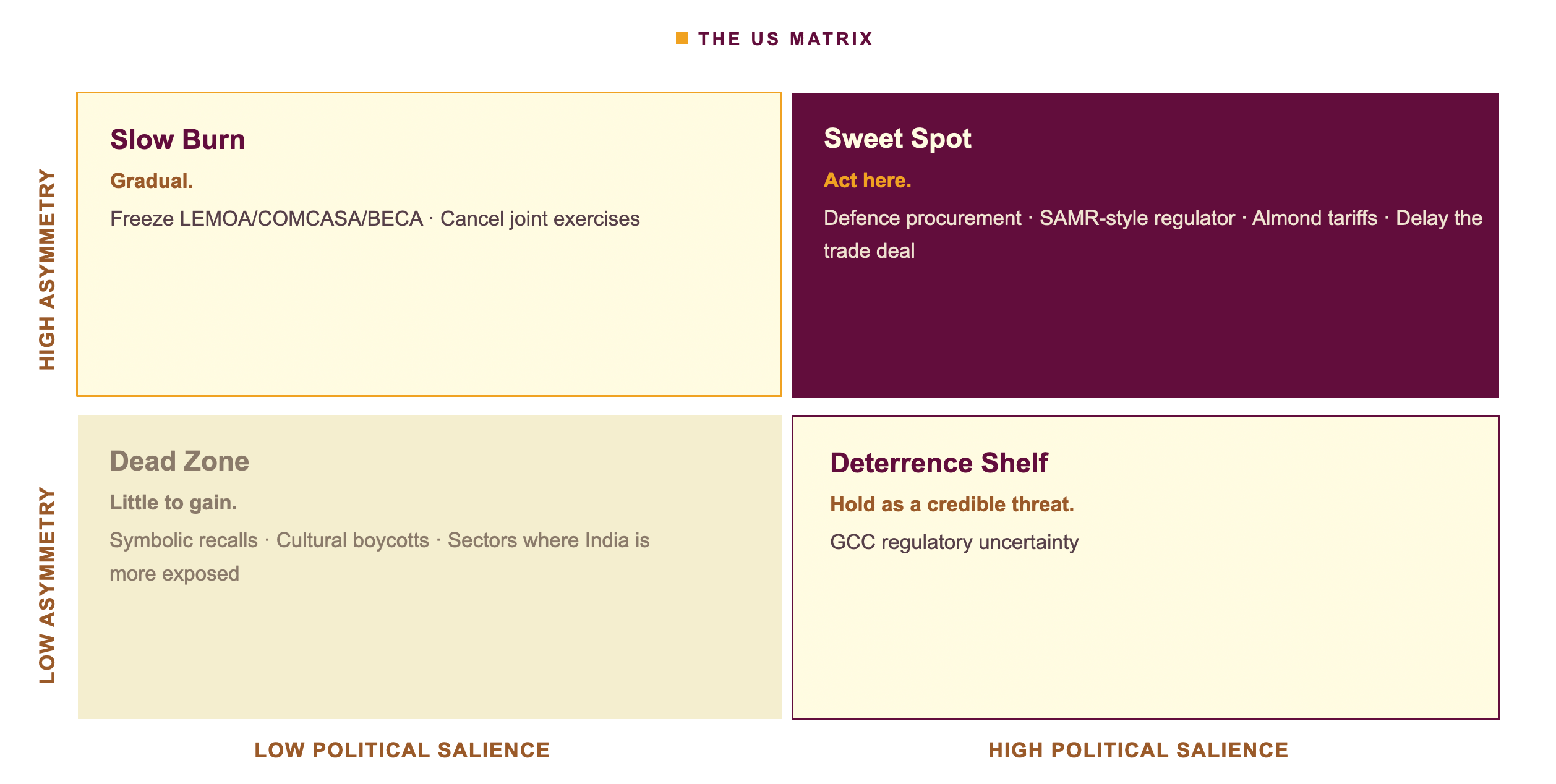
New Delhi should act against Washington where vulnerability is highly asymmetric (the US must be more exposed than India in the specific domain in which the latter is instituting measures) and where the action has high political salience for the US (it needs to generate domestic political pain in the target state). The quadrant that represents this intersection in the 2x2 matrix above is the sweet spot. It includes the following leverage options:
Altering defence procurement approach: India is a significant external buyer of military hardware produced by US defence contractors. A 2014 Financial Times report (quoting research from IHS Jane) indicated that India was the biggest buyer of US weapons in 2013, with the number pegged at $1.9 billion. A more recent report by Alan K. Kronstadt for the Congressional Research Service (US) states that India’s defence purchases from the US amounted to USD 25 billion in nearly the last two decades. “India is now the largest operator of C-17 Globemaster heavy transport and P-8I Poseidon maritime patrol aircraft outside of the United States,” according to the report. Any public announcement by India about finding alternate suppliers for big-ticket (with contracts running into billions of dollars) defence purchases would be costly for the US defence contractors. Given how enmeshed these contractors are in the US polity, with decades of lobbying experience and extensive ties to congressional delegations, they will channelise their grievances to the US Congress/administration, thereby providing one impetus for policy change vis-à-vis India. It helps India’s case that New Delhi has credible alternatives in European and domestic suppliers that can fill in for the US contractors. Another advantage of this leverage option is that it is reversible to some extent, as the hitherto sidelined US defence contractors can be engaged in future procurement cycles.
SAMR-style regulator in India: Taking a leaf out of China’s playbook, India should establish an equivalent of the State Administration for Market Regulation (SAMR) to weaponise market access for exercising leverage over countries hosting the targeted entities. China has used the SAMR instrument to target mergers and acquisitions even in cases when neither of the entities is Chinese but generates revenues from the latter’s market. As one of us (Pranay) has argued in a Takshashila blog post, “SAMR has repeatedly used its merger review process to extract concessions, protect domestic industries, force technology transfers to a third-party Chinese player, or signal political displeasure.”18 This includes blocking Intel’s acquisition of Tower Semiconductor and delaying Broadcom’s acquisition of VMware. Other investigations undertaken by SAMR include Qualcomm - Autotalks, DuPont - Rogers Corp, and Microsoft - Activision. While the per capita income varies, India is also a significant market with potential for future growth for the US companies, especially the Big Tech companies dabbling in e-commerce, social media, payments and cloud. An Indian SAMR-equivalent institution targeting the mergers and acquisitions of US companies will send a calibrated signal to US companies, which can then channelise the same to the US government.
Delay the trade deal: Although the US and India agreed to a framework deal earlier this year, they are yet to sign a proper, comprehensive trade agreement. There are multiple reasons to delay the trade deal. First, the domestic polarisation in the US polity. As one of us (Lokendra) has argued previously in a Moneycontrol opinion piece on the India-US interim trade deal: “An unfavourable mid-term result may strengthen the US Congress’ exercise of powers over taxation and tariffs, likely leading to a reduction of Trump’s leverage in negotiations with India.” Further, reaching any agreement with the Trump administration does not prevent Trump from threatening more tariffs. For example, about a year after the US announced a deal with the EU, Trump has threatened 100 per cent tariffs over digital services taxes. There is a reason why we have not seen major headlines about a new “massive” trade deal that the US has reached after the US Supreme Court struck down the use of the International Emergency Economic Powers Act (IEEPA), 1977, by the executive for imposing tariffs. Second, any trade deal must ensure that India enjoys a comparative advantage vis-à-vis other countries in the region and beyond that export a similar set of goods to the US (apparel, for instance). In this regard, the statement by India’s commerce minister that there has to be a comparative advantage for the country for any trade deal to fructify is a welcome one. With IEEPA ruled out and the usage of other legal tools such as sections 122, 232 and 301 muddied, India should wait for clarity to emerge on the US side before proceeding with a trade deal. But there is also a third reason, and clubbed with effective communication, it can be used to send a signal to Washington that transgressions would be met with a further delay in signing the trade deal and a continuation of the status quo. The outlawing of IEEPA-based tariffs has meant that the US executive is unlikely to impose discretionary tariffs on a range of countries in the way they did for much of 2025. Because affected countries are no longer trying to outdo each other in a race-to-the-bottom to please the US executive with deal offers, this also reduces the urgency for India to secure a trade deal.
Apart from the sweet spot quadrant, the other three quadrants are slow burn (high asymmetry but low political salience), deterrence shelf (low asymmetry but high political salience) and finally the dead zone (both asymmetry and political salience being low). The slow burn quadrant will include leverage measures such as freezing the implementation of foundational defence agreements that India has with the US, like the Logistics Exchange Memorandum of Agreement (LEMOA), Communications Compatibility and Security Agreement (COMCASA) and Basic Exchange and Cooperation Agreement (BECA). This will also include cancelling joint military exercises between both countries. These actions will affect the force projection capabilities of the US in the Indian Ocean region, but would not generate the political consternation that targeting of stakeholders with strong political lobbying groups would (as discussed above). The deterrence shelf includes targeting of global capability centres that India houses. There are over 2100 GCCs in the country, serving as R&D centres for some of the largest American firms. This is a low-asymmetry option, as India is significantly exposed if its actions affect GCC functioning. The introduction of regulatory uncertainty around GCCs, instead of extreme measures, would be sufficient to send a signal to the US companies and their lobbies interfacing with the US government. Finally, the dead zone has measures that India should not take, as they neither have political salience nor high exposure for the US. This includes symbolic recalls of diplomatic staff, cultural boycotts (such as that of Hollywood offerings) and targeting sectors where India is more exposed than the US.
…
It is not our argument that any of these are good options in that they would not carry any consequences for India. All of them are bad options in normal times. But given the difficult moment India finds itself in from a geopolitical point of view, the leverage options we suggest can potentially work today in influencing the behaviour of the major powers. India should double down on the long-term path of ensuring economic and technological prosperity for its people in addition to building military strength. But when faced with transgressions, it should not wait for a future moment of strength to respond when leverage options can be exercised today.
HomeWork
Reading and listening recommendations on public policy matters
[YouTube Show] In the previous edition, I discussed the OpenAI-Hugging Face Incident. In the latest episode of Watching the Wheels, we took that conversation forward, with Shruti Rajagopalan talking about her new agentic AI governance framework.
[Article] To make sense of the UPI MDR debate, check out this opinion piece by Anupam Manur.
[Book] This collection of chapters on the Geopolitics of AI is a great read. It’s written from an American perspective, but has several important ideas for discussion. And it’s available for free.
While in slightly tending towards supporting the MDR charges in UPI (based on listening and reading to Puliyabaazi), my inclination is far more weaker after reading these arguments, which also make sense. Would be great if you can clarify/put out your views on the points raised here (I've avoided the word rebuttal, as I'm interested in a balanced view)
https://x.com/deepakshenoy/status/2099936738236039385
I saw my daughter's CBSE social studies text books till class tenth. They still have a lot of anti free market, anti liberalization rhetoric in them. I have seen the term 'palampur economics' used as a pejorative in some discussion forums.
Has history-text-book been any different? What changes to history books have been made by Modi government? Do you have a list? I asked grok and got this reply: https://x.com/i/grok/share/dcad34e1e65c431e9acc788be5655c94. Is this what you are referring to?