

Programming Note: We are taking a two-week break for Dasara, and then another one for Deepavali. So you won’t see us in your email inboxes on October 11, October 18, and November 8.
India Policy Watch #1: Gandhi’s India, Forever
Insights on current policy issues in India
—RSJ
It was Gandhi Jayanti this week. Back in the 80s when I was growing up, this day had a particular routine. The morning transmission of Doordarshan would play the favourite Gandhi bhajans (Vaishnav Jan, to start with) and the Jagriti song that went ‘Sabarmati ke sant tu ne kar diya kamaal’.
The newspapers of the day would carry multiple shradhaanjalis, op-eds and personal reminiscences of Gandhians about the great man. In the afternoon, we’d all gather around the TV to watch Attenborough’s Gandhi for the umpteenth time. Later in the evening, we’d see news clips of various leaders at Rajghat paying their floral tributes, and we’d end the day watching some discussion that went by titles like Gandhi: Ek Soch. I might be exaggerating a bit here, but this routine remained unchanged for much of the late 80s and 90s.
Surprisingly, things haven’t changed much in 2026 on the national channel. I caught a few minutes of Gandhi last afternoon on DD National. All these years and multiple viewings later, I still well up at that Om Puri cameo when Gandhi is fasting unto death in Calcutta, appealing for Hindu-Muslim unity.
That scene came alive to me a few years back when I read an excerpt from Mountbatten’s account of the partition violence and the relative calm on the Bengal side in comparison to Punjab because of Gandhi’s fast. He wrote:
“In the Punjab we have 55,000 soldiers and large-scale rioting on our hands … In Bengal our forces consist of one man, and there is no rioting.”
The film aside, DD National also had a live telecast of some kind of interfaith prayer event at Rajghat with the President in attendance. I also checked the various op-ed pages of newspapers to see how many Gandhi op-eds there were during this week. I counted only three across maybe seven or eight national newspapers, both mainstream and business. There was also the ever-engaging Ram Guha on a few YouTube channels whose new book ‘Arguments with Gandhi’ was published on Gandhi Jayanti.
But that was pretty much it. Since the 80s we’ve been lamenting that all that was left of Gandhi in India was symbolism. There used to be this very famous Doordarshan ad, conceived by Aleyque Padamsee, where a hand would sketch out a rough outline of Gandhi’s side profile and then add those familiar round glasses. The voiceover went,
“The greatness of this man lies in his simplicity. Let’s try and discover Gandhi in ourselves.”
Even then I remember thinking that perhaps this was what was left of Gandhi in India. The glasses, the image on currency notes, a few main roads in cities, statues, and the convenient invocation of the Mahatma when needed.
I suspect even the symbolism is now disappearing.
Swachh Bharat Abhiyaan, which PM Modi launched with a lot of fanfare, has fizzled out. Gandhi’s glasses, the logo of the campaign, are hardly seen now. Much of India still looks as unclean as it did before Swachh Bharat. The Gandhi on the currency note is also less visible in the days of UPI and digitisation, though cash in circulation has gone up even after demonetisation, with a large part of the increase in higher denomination notes. That is a story for another day. But ordinary Indians are not dealing with notes in their everyday transactions.
There was also MGNREGA, the Mahatma Gandhi National Rural Employment Guarantee Act, probably the most important piece of Gandhi symbolism in public policy. Gandhi’s name was attached to an ambitious promise about work and dignity. Now that too has been renamed and re-architected into the contrived VB G RAM G (I won’t even attempt its expansion). Gandhi has been replaced with Ram ji, as the BJP would remind you.
So what of Gandhi’s beliefs and methods will still remain with us regardless of the attempts to erase them?
The thing that has survived best without anybody having to preserve it is the Gandhian method of protest. We saw it in July during the NEET papers leaks protest and again on Gandhi Jayanti this year against the implementation of SIR and the role of the Chief Election Commissioner. This form of protest was familiar to all Indians: march, sit on fast, make the argument in public and continue the agitation in the face of violence from the state. That is the Gandhian template of over a hundred years that no new generation in India needs to learn in classrooms. It’s in our blood.
Gandhi’s genius was in appreciating this mode of active civil disobedience in a society where the State still cares about its legitimacy. The protester did not have to dislodge the State like the communists or the fascists imagined. The protester had to make it difficult for the State to ignore him. He knew how to work in the space, however limited, in which public opinion matters and where the legitimacy of the State depends on the consent of the people.
Gandhi’s satyagraha inculcated among Indians a political culture in which disagreement did not have to become violent. There are people who argue that the British would have left India anyway after WW2 when running a colony of that size became financially untenable. That’s in the realm of conjecture. What is certain is that he knew a society that won its independence on the back of violence would never have a future where its people would learn to fight a government they dislike while living with it peacefully. That is a priceless legacy we should never take for granted.
The other Gandhian belief which will survive is his suspicion of modern civilisation. He worried about industrialisation, consumption and the idea that economic progress could be measured by producing more things at scale.
Most of his views on modernity are difficult to defend today. There is no sensible way to build a modern economy and lift the lives of 1.4 billion people while treating machinery as a moral problem. Yet, there is a question that Gandhi posed about the meaning of progress that will remain relevant. Should technology become so large and centralised that the individual loses control over his own life and the society abandons its responsibility for the generations yet to come? We continue to discover that technological progress creates its own problems that can turn into existential crises for us. Climate change and environmental degradation are evident examples.
The concentration of economic and technological power among a few Silicon Valley entrepreneurs is creating newer p(doom) scenarios. If machines can perform cognitive work, what happens to the relationship between human beings, work, economic value and purpose? I don’t think Gandhi would have had a particularly useful answer to the existential questions technology poses today. But the question he was asking about untamed technological progress at the cost of community was not entirely devoid of merit then or is now.
Then there is his unwavering belief that India will not exist, let alone thrive, without Hindu-Muslim unity. This is an uncomfortable principle in today’s political climate both because of the ascendancy of Hindutva in the body politic and because his insistence on it was so complete that it seems fake. For Gandhi, this pluralism was part of the definition of India itself. He kept returning to it even when it was politically inconvenient and personally perilous. His idea of religion was different from the modern idea of religion as a marker of political identity. He was deeply religious, but he never once believed in the superiority of one religion over another. That argument has hardly become less relevant even though he’s now seen by large sections of the Hindu right as an appeaser.
We are losing Gandhi as a symbol and as a thinker at a time when the things he worried about are relevant again. Gandhi was open to being challenged on his views, and he engaged with the most trenchant of his critics. He did this because he knew that’s the only way to find the madhyamarga. He was often wrong, at times prescient but never unprovoking. That is why we should continue to read him even if we have to disagree with him. That is Gandhi’s legacy that is worth keeping.
P.S. by Pranay: On Watching the Wheels, we discuss the many facets of Gandhi. And if there is one thing you can read on him, let it be Orwell’s Reflections on Gandhi.
Global Policy Watch: Wealth and Power
Global issues relevant to India
—Pranay Kotasthane
I spent an inordinately large part of last week following the Asian Games with my six-year-old. The Indian women’s 4x400 m relay team winning the gold had us jumping, cheering, and celebrating. The concentrated dose of thrills that such sporting bonanzas provide is priceless.
Like many of you, I had my attention pinned to the medal tally throughout the week. What caught my attention was that by the last day, the top four gold medal counts followed a geometric progression—each rung of the table was roughly half the one above it (China had 169 golds, Japan 83, South Korea 39, and India and Uzbekistan 21 each).
These figures suggest that China is far ahead of the rest. But is it really?
This question sent me down a rabbit hole. I went back to a 2021 analysis by The Economist of the Olympic Games. It found that a country’s share of world GDP, measured at purchasing-power parity, was the single biggest predictor of Olympic success. GDP alone explained 55% of the variation in medals won since 1960. By that yardstick, India looked dismal.

But this explanation seemed unconvincing to me because it discounts the role that prosperity plays in elite sport. Actually, the share of GDP blends two different things. One is scale, i.e., how many people a country has, and thus the pool of its potential athletes. The other is wealth, i.e., how much each citizen has, which goes into paying for nutrition, coaching, facilities and the opportunity cost of training. A country can have a large GDP because it is big, or because it is rich. These two routes are unlikely to produce athletes at the same rate. A populous, poor country produces fewer elite athletes per head than a sparser, richer country.
So I took another measure—GDP multiplied by GDP per capita, both at purchasing-power parity. GDP captures scale while GDP per capita captures prosperity. Since GDP is itself population times GDP per capita, the product works out to population times GDP per capita squared. In other words, it bets that prosperity matters twice as much as headcount. This hypothesis was inspired by Mike Beckley’s argument that a better estimate of national power is GDP × GDP per capita.
When I tested it on the last five Asian Games (thanks to Claude), it explained the results better than The Economist’s measure. Two results stood out for me:
Income per head on its own wasn’t a good enough predictor for the Asian Games Tally. It explained only about a fifth of the variation in medal points. For instance, rich small states like Singapore and Qatar do not top the table.
Scale and prosperity together worked better. The composite explains about half of the variation, the same as The Economist found for the Olympics.
With this yardstick, we can ask the crucial question: which country wins more than its economy predicts?
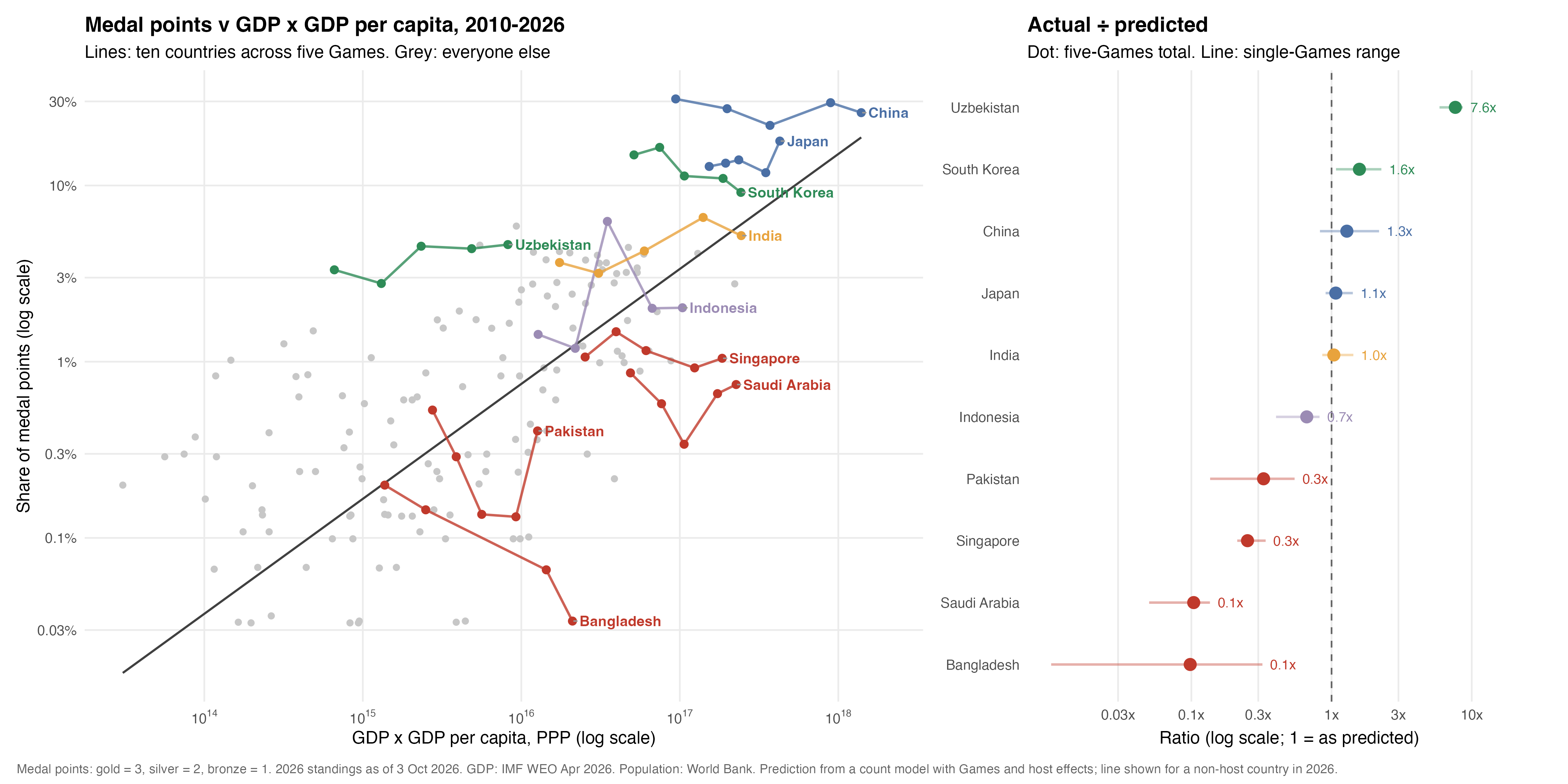
Among Asia’s big economies, South Korea is a true winner. Over the last five Asian Games, it won about 1.6 times the medal points its scale and wealth predict. It beat its prediction in all five, not just at home in Incheon.
China, by contrast, wins about 1.3 times its prediction, and Japan about 1.1 times. Both are close to what their economies would suggest. China’s haul seems huge because its economy is enormous—it accounts for about 42 per cent of the GDP of Asian Games nations and takes about 26 per cent of the medal points.
Korea is rich, with GDP per capita of nearly $69,000 at purchasing-power parity, and my measure gives that wealth heavy weight. Even so, its scale and wealth together predict about 8 per cent of the medal points over the five Games, whereas Korea won about 12.5 per cent. Its edge is consistent across shooting, fencing, archery, taekwondo, and more, suggesting a system rather than a lucky Games.
The biggest overperformer, though, is Uzbekistan, which wins nearly eight times what its economy predicts! Actually, all post-Soviet countries are overperformers. This has something to do with the sporting facilities and partly with the overindexing of wrestling, judo, boxing and kurash in the Asian Games agenda.
The rest of the table looks like this.
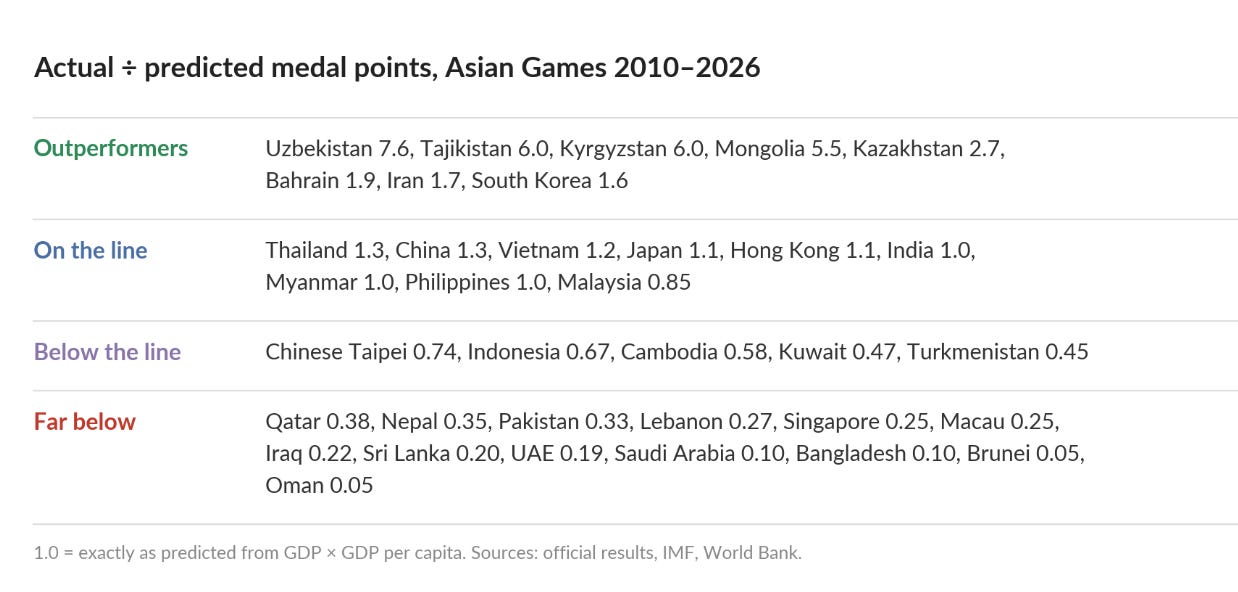
We can gather five points from this table:
Central Asia is in a league of its own. Soviet-era sports schools and contact sports put them in another orbit (I have no idea what went wrong with Turkmenistan).
India is on the line. Measured by GDP alone, India underperforms in four of the five Games. Once income per head enters the picture, India wins about what its economy predicts. The long-running lament about India’s medal tally is mostly a lament about India’s poverty.
The rest of the Indian subcontinent underperforms. Pakistan wins a third of its prediction, Bangladesh a tenth. Bangladesh won just one bronze this year with nearly 2 per cent of the GDP of Asian Games nations.
The fungibility of Gulf money into medals is poor. Saudi Arabia, the UAE and Oman are at the bottom. Bahrain, which naturalises athletes, is the exception.
Singapore and Indonesia underperform. Singapore’s prosperity does not compensate for its lack of scale, while Indonesia seems to be far below its potential.
So the right question from an Indian perspective is not “why so few medals?” It is instead, “what would it take to beat the prediction?” And the clues to that might be found in Seoul and Tashkent rather than in Beijing.
India Policy Watch #2: When the Chips are Down
Insights on current policy issues in India
—Pranay Kotasthane
In edition #360, I analysed India Semiconductor Mission’s (ISM) second avatar. My point was that the shift in focus to chip design was much needed, even though I felt that the policy is way too focused on indigenisation of commodity chips. My concern was that the stringent requirements around IP ownership and sources of investment mean the policy is too focused on plucking low-hanging fruit rather than turning chip design capabilities into strategic leverage.
Earlier this week, former Minister of State for Electronics & Information Technology Rajeev Chandrasekhar also made a similar point in his Indian Express column. He argues that ISM2.0 has two missing pieces:
India has no dedicated semiconductor research institution with the required depth. A National Semiconductor Research Institute — co-invested by government and industry, mandated to develop process technology, design IP, and the talent pipeline — was part of ISM 1.0’s vision. It must not be delayed further.
(AI) Inference is wide open. The diversity of inference requirements across cloud, edge, device, defence, agriculture, and industrial applications is so large that no single architecture can dominate. Purpose-built inference chips command 50-70 per cent gross margins. India has 1,25,000 chip design engineers qualified to build them. India’s DIR-V programme on RISC-V open-source cores eliminates ARM licensing costs. IndiaAI’s sovereign compute programme, defence procurement, 5G infrastructure, and a billion-user domestic market provide ready demand anchors.
What is missing is capital that funds Indian fabless companies all the way to commercial tape-out, not just prototypes. DLI must be expanded. ISM 2.0 should create a Chip Design Commercialisation Fund at Rs 1,000-crore scale — modelled on NIIF — and designate at least two sovereign AI inference chip programmes with guaranteed government offtake. [Rajeev Chandrasekhar, Indian Express]
These are excellent criticisms. That someone who led the charge in formulating India’s semiconductor policies in 2021 couldn’t get these changes through shows how government policies operate. Betting on a future technology or product with committed offtake guarantees is hard. So is committing to a national research institute, whose gains are diffuse and long-term. Thus, the government has instead stuck to an easier goal of indigenising mass-market chips. That goal might well be achieved, and when that happens, the government would deserve praise for having come this far ahead. But if the aim is to turn India’s chip design potential into geopolitical leverage, the current policies do not do that.
HomeWork
Reading and listening recommendations on public policy matters
[Article] This Noema article by Ken Archer and Nobel Suhendra on the overblown fears of rogue AIs is a must-read.
[Podcast] This episode of the ChinaTalk podcast is making waves. It is an excellent and grounded take on China’s macroeconomy.
[Puliyabaazi] Don’t miss the puliyabaazi on the legendary Tagore-Gandhi puliyabaazi.
Excellent analysis on international games, Pranay. I think to explain Uzbekistan and other such small but successful countries (maybe Australia?) you may need to add a variable for "legacy" or "focus". UK, Australia and some of the old Soviet economies would need that for explanatory power. Btw, have you tried this on coffee consumption. Years ago, I had modelled that international medals and coffee consumption were a function of prosperity. Might be an interesting addition to your thesis.
I think you should get Claude or something to do a full blown ml model of medals won against both population and gdp. I think we’ll find some weird exponent tbsp explains it.